Post 7: Heather Owen, EngEd 270, Chapter 6: Developing Fluent Readers and Writers
Vocabulary:
- Automaticity: recognizing words automatically, without conscious thought.
- Speed: Fluent readers read at least 100 words per minute by the third grade
- Prosody: The ability to read sentences expressively, with proper phrasing and intonation
- High Frequency Words: the most common words that reader encounter over and over again. Word walls are a great place for these.
- Morpheme: root word, the basic, most meaningful part of a word
- Prefixes: added to the beginning of a root word to make it into a different word than the root.
- Suffix: added to the end of a root word to make it into a different word than the root. There are two kinds of suffixes, inflectional and derivational.
- Phonogram: a symbol representing a vocal sound
- Syllables: a unit of pronunciation having one vowel sound, with or without surrounding consonants, forming the whole or a part of a word, e.g., there are two syllables in water and three in inferno.
- Listening Centers: Students read along in a book at their instructional reading level while listening to it being read aloud
- Quickwriting: A quickwrite is a first draft response to a short piece of writing, usually no more than one page of poetry or a short picture book, but differs from prompts and freewrites. Quickwrites allow us to write fast without censoring — it’s what the subconscious allows us to say.
- Simulated Journals: During this activity students take on the role of a character from a book and write entries from that character’s viewpoint in a journal as if the character was writing it.
Tompkins, G. E. (2017). Literacy for the 21st Century: A balanced approach. Pearson.
Key Concepts:
Fluency is the ability to read and write without effort and with efficiency. Becoming Fluent readers and writers is a developmental stage for literacy.
- Typically, most students reach the level of fluent by the time they are in second or third grade. This is because of being given many authentic literacy learning experiences and chances to practice their reading and writing skills.
- This stage is extremely important because it is very hard to have comprehension without fluency.
- A student cannot focus on concepts of the story if they can barely understand the words that they are reading.
- Research has found that fluent readers comprehend what they are reading much more easily than their non fluent classmates, and the same is true in writing!
- CCSS: says that reading fluency is an essential foundational skill that students must develop by the fourth grade to become proficient in reading.
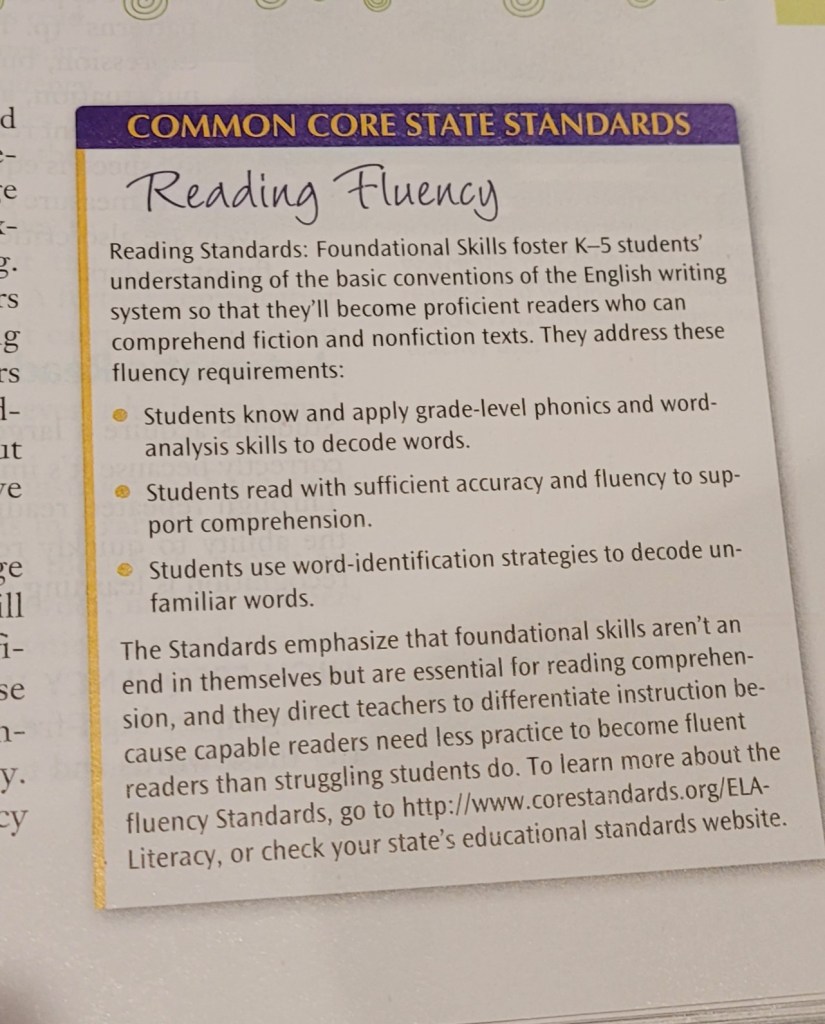
Tompkins, 2017, pg. 185
Reading Fluency is the ability to read quickly, accurately, and with expression. To do this, students need to be fluent or be able to recognize most words easily and decode those they don’t know.
- Fluent readers can comprehend what they are reading better because of these skills.
- Reading fluently involves three components:
- Automaticity: Recognizing words without conscious thought, and they can identify unfamiliar words almost as quickly.
- Its critical that students understand most of the words they are reading because otherwise they must slow down to decode words. Slowing down affects comprehension by interrupting the flow of information.
- Typically, it is believed that students can understand what they are reading if they understand at least 95% of the words in the text.
- Some people believe that 95% still isn’t enough, and that students will still be stopping too much to fully comprehend the text; they believe that 98-99% is the best bet.
- Speed: Fluent readers will be able to read at least 100 words per minute.
- This is a stage that is typically reached in third grade.
- After readers reach this stage, their speed will continue each year.
- By eighth grade for example, students typically can read 150 words per minute
- Most adults can read around 250 words per minute
- In addition to WPM, fluent readers also vary the speed of their reading depending upon the kind of reading they are doing.
- Prosody: Fluent readers can read sentences with expression, using proper phrasing and intonation for sentences to make sense. This is known as prosody.
- Beginning readers read word by word and struggle to express any rhythm or intonation in their reading.
- As readers become more fluent, they can read more and more like how words are regularly spoken.
- Many tests only assess the speed that students read with. This is leaving out the very important concept of prosody which often helps with comprehension.
- Automaticity: Recognizing words without conscious thought, and they can identify unfamiliar words almost as quickly.
- Automatic Reading: as students learn to read they acquire a large stock of words that they become able to read automatically without having to consciously think about how to pronounce them.
- Through more and more repeated lessons with reading and writing, students develop the skill of automaticity.
- In order to do this students have to learn each word’s unique letter sequence.
- High Frequency Words: Words that students will come across repeatedly and become very easily recognized.
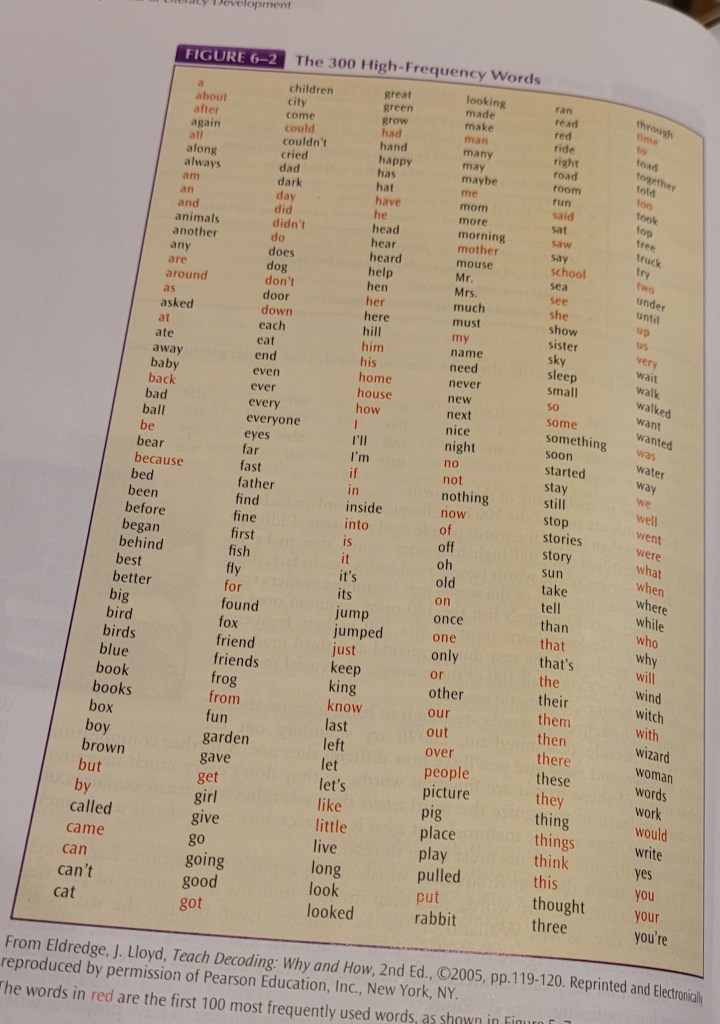
- There are many different iterations of what the most important high frequency words are.
- There is a list of 100 words that account for more than half of the words that people read and write.
- And, there is even a list with 300 words that account for about 72% of the words that people read and write.
- If fourth graders do not know these words, it is of the utmost importance that they learn them so that they can become automatic readers.
- Many of the high frequency words can be hard for some students to learn because they are hard to decode. Many of them can’t be sounded out.
- Teachers must teach these with explicit instruction.
- One strategy is teaching 3-5 of the words per week and having students use them in their reading and writing assignments.
- The words aren’t taught in alphabetical order, but rather, teacher’s match words together that have similar structures.
- Teachers create word walls with these words and add to them throughout the school year as students learn more words.
- Kindergarten teachers might start with student’s first names and simple common words that students see often. Then add the 24 highest frequency words from the list, by teaching 1 to 3 a week to the class.
- First grade will begin with the 24 words that were taught in kindergarten and build upon that.
- This helps fluency to follow them throughout different grades with different teachers.
- Teaching high frequency words is not a simple task and there is a chant and clap procedure that can be used.
- See and hear the word
- Say the word
- Spell the word
- Spell the word again
- Write the word
- Check the word
- Say the word again
- Depending on student’s level of familiarity with the word teachers can lengthen or shorten this process to help with teaching to word to the needs of their students.
- Word-Identification Strategies: Students use four different strategies to help with word identification.
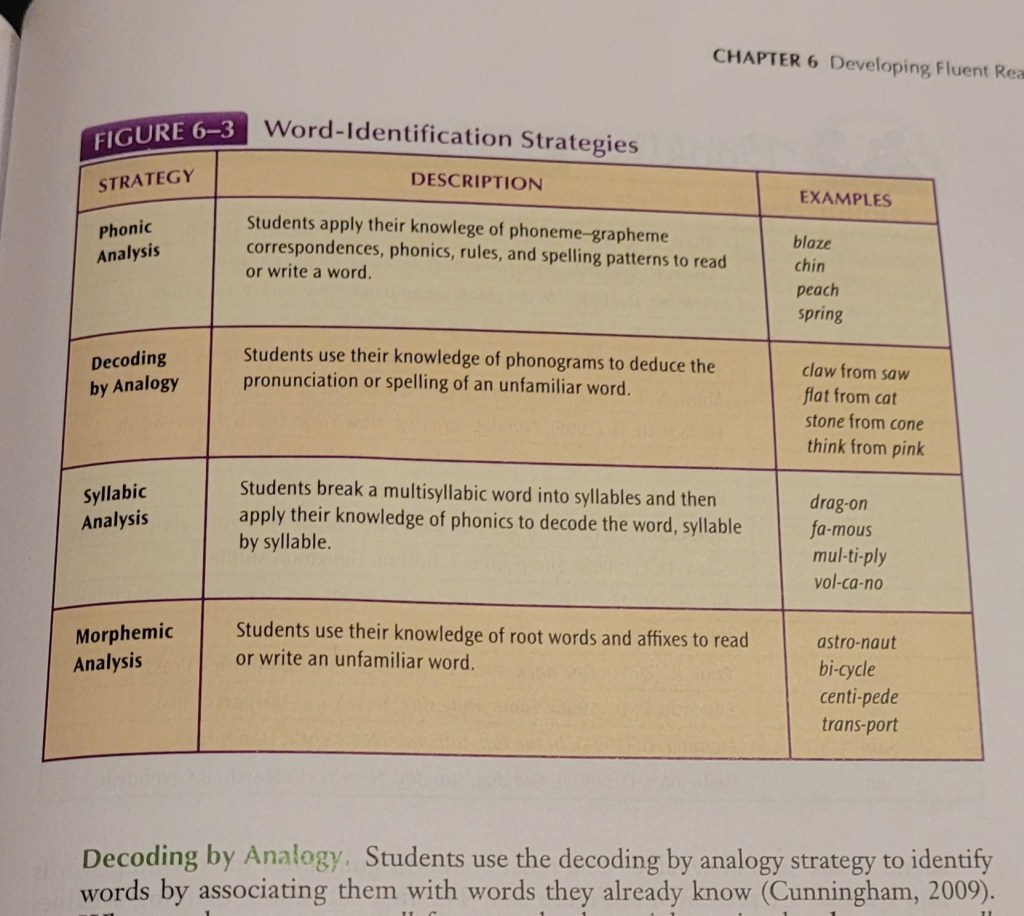
Tompkins, 2017, pg. 191
- Phonic Analysis: Typically used by the earliest readers.
- Students use what they know about phoneme-grapheme correspondences and phonics rules to decode words in this strategy.
- Even though English is not a one-to-one correspondence language, this strategy is still incredibly useful because almost every word includes a part that is phonetically spelled the way it sounds.
- Early readers will often attempt to guess at words by knowing the initial sound that it makes
- These guesses are usually wrong, but it’s a step towards making connections between the sounds of letters and words.
- Decoding by Analogy: students use this strategy to identify words by associating them with words that they already know.
- Phonograms are important here. When you see the word small you may notice one of the smaller words within it, all
- Students may try to think of other words that end with all to help identify what the word is. Example: ball, tall, call
- Students use this strategy when they work with “word families”
- To use this strategy the student must be familiar with consonant blends and digraphs, and be able to manipulate sounds.
- Teachers can also use books that use particular phonograms
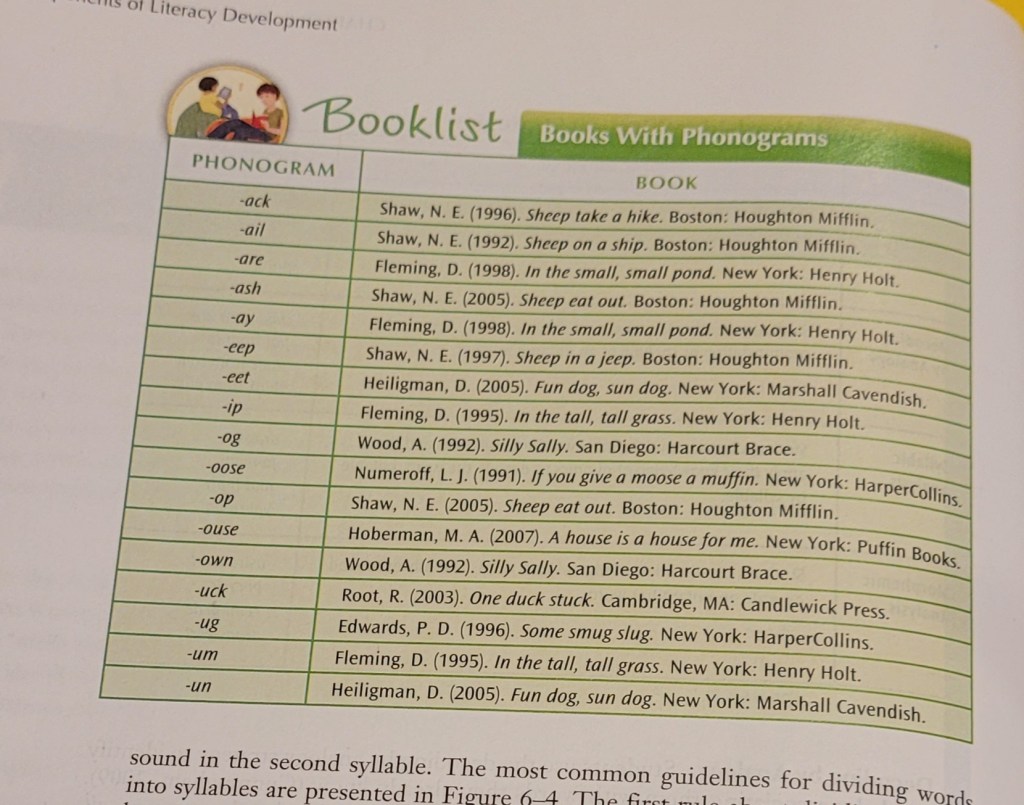
Tompkins, 2017, pg. 192
- Syllabic Analysis: More experienced readers use this strategy
- Students will divide longer words like angry, pioneer, and yogurt into syllables to help to decode the word.
- Each of these broken parts will have one vowel sound in it.
- NOTE: sometimes there will be more than one vowel together that create a single vowel sound.
- Dividing syllables can be complicated for some students, so it is important for them to learn these rules
- Students will divide longer words like angry, pioneer, and yogurt into syllables to help to decode the word.
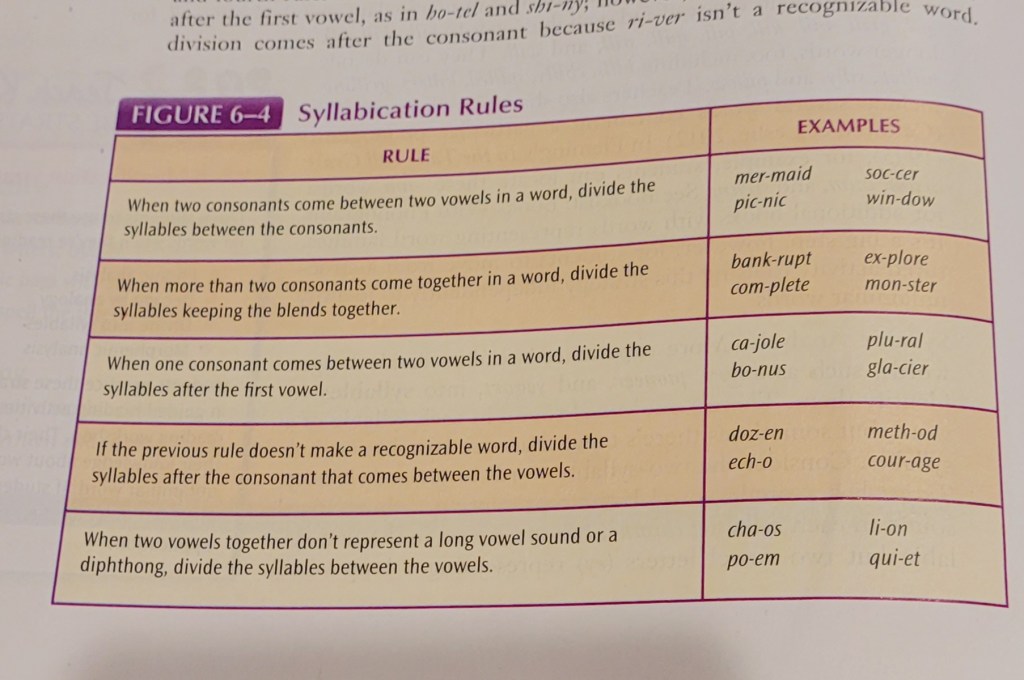
Tompkins, 2017, pg. 192
- Morphemic Analysis: Students use this to identify multisyllabic words
- They locate the root work by removing the suffixes and prefixes. A root word is a morpheme
- Prefixes are added to the beginning of a root word
- Suffixes are added to the end of the word
- There are two kinds of suffixes; inflectional and derivational
- Inflectional suffixes are endings that indicate verb tense, person, plurals possession, and comparison
- In contrast, derivational suffixes show the relationship of the word to its root word.
- Knowing the meaning to word parts provides context and facilitates word identification.
Reading Speed
- Students must develop an adequate reading speed or rate to have the ability to understand the meaning of what they are reading.
- Researchers have identified expected reading speeds for different grade levels, but teachers should use these with caution because speed does not necessarily equal fluency.
- These factors can affect student’s reading speed
- Preexisting background knowledge about the subject
- Knowledge about the genre or text style
- Students who speak English fluently will be naturally faster at reading than someone who is trying to learn how to read English.
- Over time, students will learn to be more strategic readers: varying their speed depending upon the text.
- Teachers provide daily practice opportunities with
- Choral Reading
- Readers Theater
- Listening Centers
- Partner Reading
- NOTE: Remember that to help with fluency students need to find the reading interesting and read the words with 98-99% accuracy.
- Once students are fluent readers teachers can work on things like reading stamina.
Prosody: When students read expressively, they add meaning to the words. There are multiple components of this:
- Expression: Students read with enthusiasm and vary the level of energy in their reading go match their interpretation of the text
- Phrasing: Students will add their own phrasing as they read by grouping words together and apply stress and intonation
- Volume: Students vary the loudness of their voice to add meaning to text.
- Smoothness: Students read with a smooth rhythm with self-corrected breakdowns
- Pacing: Student read at a comfortable conversational speed
- While these components may seem more aimed towards read aloud, they are also important to silent reading as a student’s internal voice also affects comprehension of text.
- Teachers can emphasize the importance or prosody by modeling expressive reading during read aloud and using the think-aloud procedure to reflect on how their expression affected the meaning of the text.
Assessing Reading Fluency
- Throughout the school year teachers will informally monitor students reading skills by listening to them during read aloud, or shared reading.
- At the beginning of the school year, and periodically throughout the year, teachers will do assessments to test students’ accuracy, speed, prosody.
- Automaticity: Teachers will check students ability to identify high frequency words and their ability to use skills to decode words.
- Kindergarteners are expected to read 24 high frequency words, 1st grade 100, 2nd grade 200, 3rd grade 300
- Teachers can use the Dolch list or the Fry list of words
- Automaticity: Teachers will check students ability to identify high frequency words and their ability to use skills to decode words.
- Speed is assessed by teachers timing students as they read a passage that includes various high frequency words.
- Teachers can use these assessments to compare students in their class and other students at their grade level.
- Prosody is a little trickier to assess. Teachers start by listening to students read aloud and noting things like pace and expression. Rubrics are great for assessing this.
- These kinds of assessments throughout the year are crucial for teachers to understand where their students are at with reading and their understanding.
Some examples of assessment tools
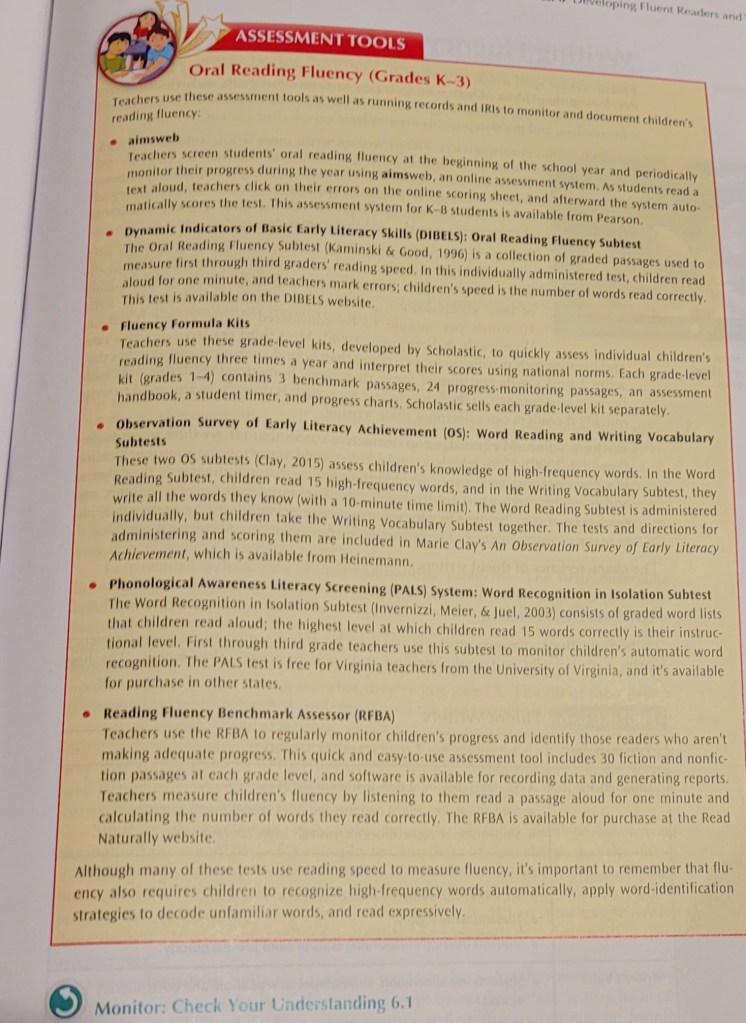
Tompkins, 2017, pg. 197
Writing Fluency
- Fluent writers have many of the same characteristics that fluent readers do. They are able to spell words automatically and write quickly so that they can focus on developing clear ideas.
- Fluent writing seems like talking- it should have ‘voice’
- Fluency is crucial for writers, just like for readers.
- Automaticity: Fluent writers should be able to write with accuracy and speed automatically. To be fluent they must understand how to spell high frequency words.
- Speed: Students need to be able to write quickly so that they can keep pace with their thoughts.
- NOTE: Students should be able to write 10 words per minute to be fluent writers.
- NOTE: Do not sacrifice neatness for speed. There is no point in writing quickly if you can’t read it.
- Writer’s Voice: Voice (which is very similar to prosody) is the writer’s personality, language use, and pacing in their writing. Writers develop a voice with their word choice and how they structure their sentences.
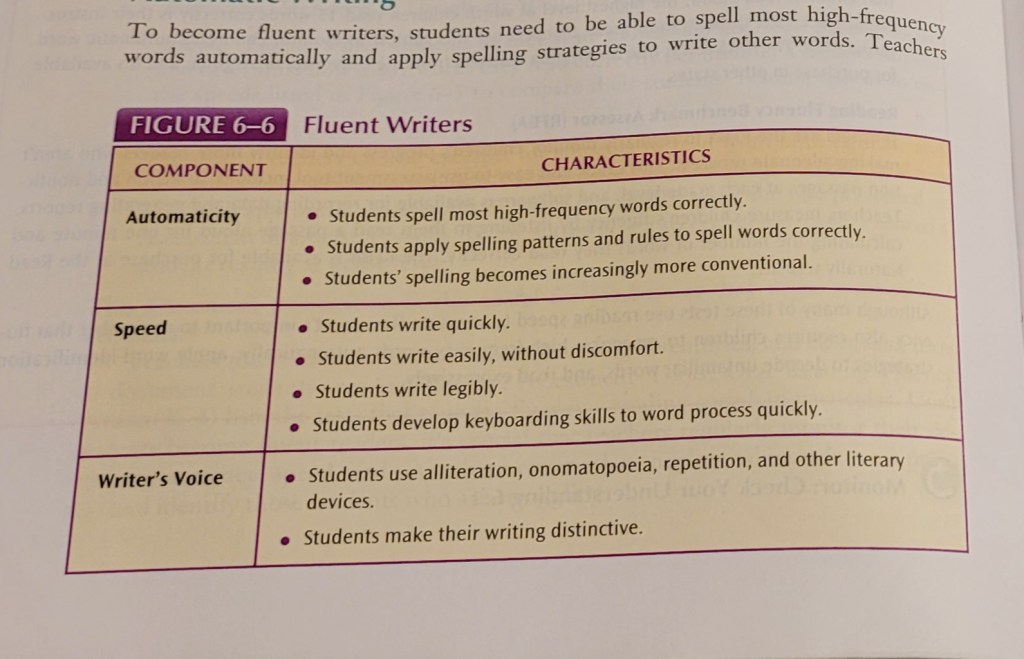
Automatic Writing
- To be fluent writers students need to be able to spell most high frequency words automatically and apply spelling strategies.
- Typically teachers are able to teach students these words at the same time that they are teaching students to read them. They teach a certain amount (5 or 6) each week and provide daily opportunities for practice with these words.
- Students write the words and sentences they are learning on white boards
- Students use letter cards or magnetic letter to spell the new words
- Students write the words during interactive writing activities
- These activities are great because they can be teacher led at times or used in literacy centers.
- Typically teachers are able to teach students these words at the same time that they are teaching students to read them. They teach a certain amount (5 or 6) each week and provide daily opportunities for practice with these words.
- When they are just learning to spell high frequency words, students may write word how they sound to them. They might spell the word baby as BABE or house as HUS because of their understanding of phoneme-grapheme correspondences.
- With more authentic practice, students will get better at this skill.
- Students will learn to think it out rather than sounding it out.
- Writing Speed:
- To become fluent writers, students need to be able to write things down as quickly as they think it up. They must spell automatically and be able to use legible handwriting without having to think about it.
- Students need to know how to hold pencils properly
- Students need to learn how to form manuscript letters and sometimes cursive letters
- Left handed students face unique problems. Right handed students naturally will write closest to their body and out wards to the right. Left handed students will write left to right, but in doing so will cover up what they wrote.
- This can cause issues where students will adopt a “hook” position when writing so that they can still see their writing.
- To handle this, it is helpful to teach left handed writers to hold their pencils about an inch higher than right handed students would as it will allow them to see their writing more easily past their pencil.
- Another issue they may face is the tilt of their papers. Left handed students will have to tilt their papers to the right to help make writing letter forms easier.
- Finally, one other issue for left handed writers is slant. Left handed students may need to slant their letters to make writing them more comfortable.
- This can cause issues where students will adopt a “hook” position when writing so that they can still see their writing.
- Students develop writing speed through practice. What is most helpful is when students have many different opportunities for practicing writing every day.
- If students are having legibility issues, teachers first will look into the way that the student holds the writing utensil. From there, they will watch to see how students form their manuscript letters.
- At times you may need to slow a student down to help them work on legibility.
- Keyboarding is also incredibly useful in this age of technology. Many students are now taking keyboarding classes as early as kindergarten to set them up for success in later years.
- To become fluent writers, students need to be able to write things down as quickly as they think it up. They must spell automatically and be able to use legible handwriting without having to think about it.
Writer’s Voice
- When someone is writing, their writing should flow how they would speak.
- As students get more experience with reading and writing they will develop with own writing ‘voice’
- This can include learning to vary
- Tone
- Formality
- Word Choice
- Sentence Structure
- Students should be given a lot of opportunities to note the voices of other authors throughout their literacy classes to help to model what a writer’s voice is.
- Keeping journals and reading logs are a great place to start developing students voices as writers.
- This can include learning to vary
Assessing Writing Fluency
Teachers will assess their students writing fluency in a few different ways. While assessing it they will focus on:
- Whether or not students can spell most words accurately
- Whether students are able to write quickly enough to finish assignments in time, or do the students take a long time to finish or avoid writing altogether
- Are students writing legibly
- Can students write effortlessly or is it an uncomfortable process for them
- If the students are struggling with their writing fluency, teachers will look for issues with their automaticity, speed, or voice, and assess from there.
Reading fluency tends to occur before writing fluency, but the two are very clearly connected.
Nurturing English Learners
- It is unlikely that ELLs will become fluent writers until after they become fluent readers, and they will not become fluent readers until they are able to speak fluently.
- The important thing to remember is that ELLs will do well by being emersed in language rich environments.
- Automaticity: This can be a harder and longer process for ELLs as many of the high frequency words can be hard to decode.
- These words are abstract, often hard to spell, and violate a lot of the spelling rules that English words tend to follow.
- NOTE: Accents cannot be eliminated. There will be speech variations due to accents. Some sound in English are not present in other languages, so give ELLs extra time to understand and grasp these sounds.
- Speed: ELLs speed with reading and writing will be impacted due to limited background knowledge.
- By helping ELLs to develop background knowledge, teachers can help to increase their speed.
- Expressiveness: ELLs intonation patterns typically reflect what they were used to in their native language.
- To help eliminate this problem, teachers must help ELLs to understand punctuation
- Echo Reading: Teachers will read a passage expressively and have the EL repeat it back, attempting to also use the same expression.
- Automaticity: This can be a harder and longer process for ELLs as many of the high frequency words can be hard to decode.
Dysfluent Students
- It is estimated that 10-15% of older students have trouble with reading and writing
- In some classrooms this problem is even more widespread. Students below grade level will struggle to decode words, read with appropriate speed, or read with expression.
- These students will also struggle to get their thoughts into writing.
- It is CRUCIAL that teachers find ways to help these students get caught up as comprehension cannot improve if a student is not fluent.
- Students in fourth grade and beyond who are not fluent are called dysfluent. They will read hesitantly and without expression. They also often will complain that their reading doesn’t make sense
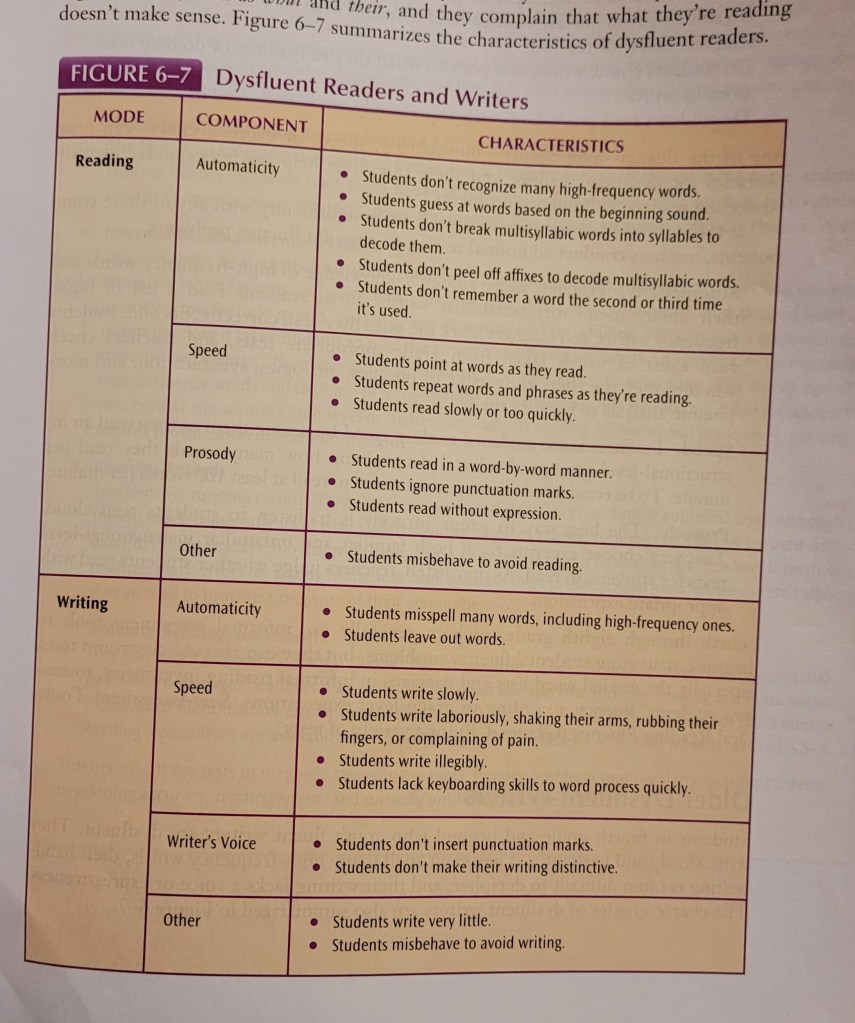
Tompkins, 2017, pg. 203
- Students who cannot read fluently often struggle with their comprehension.
- A major downside is that research has failed to find any common characteristics that cause dysfluent readers. Some struggle with decoding, some with speed, some with expression. With so many different causes, it can be hard to handle.
- Teachers can find ways to help students in this situation by screening them and considering these questions
- Can students read most words automatically or do they have to stop to decode things?
- Are students able to identify most grade appropriate multisyllabic words?
- Do students read quickly enough to understand what they’re reading, or do they read too slowly or too fast?
- Do students chunk words into phrases when they’re reading, or do they read word by word?
- Do students read grade-level texts expressively or do they read in monotone?
- Teachers then try to identify what they specifically are having trouble understanding
- Automaticity: Can students read a list of high frequency words? Can students read a list of grade-level text words? What do students use to read words that they don’t know?
- Speed: Teachers will assess reading speed by timing them as they read an instructional-level passage aloud for one minute. This will help teachers to gauge how many word per minute the student is capable of reading. To be considered fluent, students need to read at least 100 words per minute.
- Prosody: Teachers will listen to students read to assess this. Teachers will choose both familiar and unfamiliar texts for the student to read from. They will then listen to see what expression the student uses as they read.
Older Dysfluent Writers
- Students who are dysfluent will write slower and much more hesitantly.
- These students typically will struggle to spell high-frequency words, will have handwriting that is hard to decipher, and lack voice in their writing.
- It is typically easy to identify dysfluent writers because they write slowly and accomplish very little.
- They will often complain that their hands and arms hurt
- Their slow writing process interferes with their ability to get their ideas on paper
- Teachers consider these questions when assessing writer fluency
- Do students spell most words automatically or do they have to stop to sound out words?
- Do students write quickly enough to complete assignments or do they write slowly? Or do they try to avoid writing entirely?
- Is the student’s handwriting legible?
- Do students write laboriously or complain that their hands hurt?
- If the observations of the teacher appear to show that the student is not fluent in writing, a teacher will then look at different possible causes of these fluency problems:
- Automaticity: Teachers can assess this with spelling tests or by examining writing samples of the student. Fluent writers will spell most words correctly.
- Speed: Teachers time students as they write compositions of one to two paragraphs in length to assess writing speed. To be fluent, students should be able to write ten words per minute.
- Writer’s Voice: Teachers reread compositions students have written to evaluate their style. This can be trickier to assess as there is no set standard for voice. Comparing students to other students at their grade level is one way to begin to assess voice however.
Obstacles to Fluency:
- There may be one or several obstacles that your students are facing that impact their fluency.
- It is important for teachers to provide targeted instruction focusing on the students that need fluency help, and those that do not.
- Provide explicit instruction to diagnose fluency problems
- Increase the time that students have to read books at their independent levels
- Model fluent reading and writing often
- Clarify the connections between reading fluency and comprehension and between writing fluency and effective compostitions
- Increase students opportunities for writing.
- The amount of reading and writing that students do makes a critical difference in their fluency capabilities.
Obstacle 1: Lack of Automaticity: Teachers will use explicit instruction to teach students to read and write high frequency words. Each week they will focus on 5 or 6 words and give students activities to practice them like:
- Students locate examples of the words in books they are reading
- Students practice reading flash cards with the words to partners
- Students play games, such as Concentration, using the words
- Students write the words and sentences they compose with them on whiteboards
These activities provide practice that is crucial to helping increase fluency.
- Word Walls are also incredibly helpful
Remember, targeted instruction is only part of the solution.
Obstacle 2: Unfamiliarity with Word-Identification Strategies:
Teachers will include these components into their intervention programs with students
- Develop student’s background knowledge and word bank prior to reading
- Teach good word identification strategies
- Provide time for reading and writing practice
Dysfluent readers need more time for reading books at their independent reading level and for writing on topics that interest them.
Obstacle 3: Slow Reading Speed
Activities to assist student in increasing reading speed:
- provide daily opportunities for student to read and work on their reading stamina
- they often don’t read at home, so that time needs to be made up at school
- Take every opportunity possible to get in more practice time
- Repeated readings: read the same story 3-5 times to help improve speed and accuracy.
Obstacle 4: Slow Writing Speed
- The best way to improve students’ writing speed is through lots of writing.
- Activities for the student to increase their writing speed:
- Quickwriting-write without stopping for 5 or 10 minutes
- Reading logs
- Simulated journals-write from the character’s point of view
- Learning logs-taking notes, graphic organizers
Obstacle 5: Lack of Prosody
- Activities to help with expression when reading:
- teacher works with student to break sentences into phrases and reads the sentences expressively
- choral reading
- echo reading
- readers theatre
Obstacle 6: Voiceless Writing
- Activities to help student develop voice in their writing:
- lots of reading and writing
- practice their voice during informal writing
- model their writing off of other types of writing
- write everyday for 15-20 minutes
Source:
Tompkins, G. E. (2017). Literacy for the 21st Century: A balanced approach. Pearson.
Videos:
What is Fluency? How to Improve Reading Skills
- Fluency is the ability to automatically retrieve the words you are reading.
- Fluency = more comprehension
- Lack of Fluency = Lack of comprehension
How can we help a lack of fluency skills: PRACTICE!!!!
Source: YouTube. (2017). YouTube. Retrieved November 1, 2022, from https://www.youtube.com/watch?v=Dkb7_U06hfE&ab_channel=BonnieTerry.
Reading expert Linda Farrell: Mastering Reading Accuracy
Sometimes when students get stuck on a word it is important to allow them to slow down.
Give them an opportunity to try to figure out the word using their decoding skills, but if they still struggle to get the word give it to them. Then have them practice saying the word. Then have them reread the sentence with the new word. This will help them to recall these words to memory.
As teachers it is important to correct inaccurate readings. If we don’t it can set students up for poor comprehension.
The sentences:
The horse got a cold.
The horse got cold.
Have two very different meanings simply by missing a. Accurate reading habits are crucial to good comprehension.
Source: YouTube. (2019). YouTube. Retrieved November 1, 2022, from https://www.youtube.com/watch?v=h9arfAtnI6c&ab_channel=ReadingRockets.
Classroom Application:
Prior to reading this chapter I did not fully understand how important fluency is to comprehension. I am currently working with a group of second grade students and while working with them it has become extremely clear that there are some students who are struggling with their reading, but being a student in literacy education, I wasn’t certain what I could do to help these students catch up to their classmates.
When a student is behind grade level the best way to get them caught up is PRACTICE. For early readers, flashcards and the like can be helpful, but nothing beats practice. Many of our readers who are struggling feel that reading and writing are painful experiences and will do whatever they can to avoid it. They are not practicing their reading and writing skills in the home, because of this dislike, and so we must ensure that they get ample time to practice their skills within the classroom.
I enjoyed reading how there are so many different assessments to troubleshoot issues that your students may be having with reading, comprehension, writing, or fluency in general.
I also think the chapter made a great point when it mentioned that while it is important to take note of and give practice to those who are struggling to be fluent readers/writers, we also must keep our average or above average students in mind. Especially in younger grade levels! If we, as educators, let simple reading and writing mistakes occur with our students who are fluent, we are setting them up to develop habits that will hurt their reading and writing in the future.
 Heather Owen : Reading and Language Arts Methods Notes
Leave a comment