Post 6: Heather Owen, EngEd 270, Chapter 5: Cracking the Alphabetic Code
Vocabulary:
- Minilessons: minilessons are concise, explicit lessons with a purposeful application in building your students’ independent reading competencies or writing competencies.
- Interactive Writing: a dynamic instructional method where teachers and students work together to construct a meaningful text while discussing and working on the details of the writing process.
- Phoneme: the smallest unit of sound. Usually identified with diagonal lines like: /h/
- Grapheme: A Grapheme is a symbol used to identify a phoneme; it’s a letter or group of letters representing the sound. You use the letter names to identify Graphemes, like the “c” in car where the hard “c” sound is represented by the letter “c.” A two-letter Grapheme is in “team” where the “ea” makes a long “ee” sound.
- Graphophonemic Awareness: the ability to match up letters or graphemes in the spellings of words to sounds or phonemes detected in their pronunciations: for ex- ample, recognizing that the word chase has three graphophonemic units
- Phonemic Awareness: The ability to hear and manipulate the sounds in spoken words, and the understanding that spoken words and syllables are made up of phonemes
- Phonics: demonstrating the relationship between the sounds of the spoken language, and the letters or groups of letters or syllables of the written language
- Phoneme-grapheme correspondences: the process of matching both the grapheme and phonemes together and vice versa. GPC fits into the phonics framework and allows children to blend words both written and orally.
- Etymology: the origin of words and the way in which their meanings have changed throughout history
- Alphabetic Principle: Connecting letters with their sounds to read and write
- Consonants: B, C, D, F, G, J, K, L, M, N, P, Q, S, T, V, X, Z and often H, R, W, Y
- Consonant blends: two or more consonants that are next to each other and each letter sound is pronounced
- Consonant digraphs: two or more consonants that, together, represent one sound
- Vowels: A, E, I, O, U and sometimes W and Y
- Breve: a symbol (˘) written or printed above a vowel to show that it is pronounced with a short sound
- Macron: a symbol (¯) placed over a letter to represent a long vowel sound.
- Vowel digraph: the distinctive perception of one sound when two vowels are placed together in one word. e.g., ow, oa, ie, ea
- Diphthong: a sound formed by the combination of two vowels in a single syllable, in which the sound begins as one vowel and moves toward another
- Invented Spelling: One of the very first types of spelling students use. This is where they will spell things anyway that they think up- they do not follow any particular speech patterns or rules.
- Morphemes: the smallest meaningful units of meaning. Morphemes are important for phonics in both reading and spelling, as well as in vocabulary and comprehension.
- Eponyms: An eponym is a person whose name has given rise to the name of a people, place, etc., or a personal name which is used as a common noun. This person may be living or dead, a fictional character, or a hero, etc.
- Orthography: the conventional spelling system of a language
Source:
Tompkins, G. E. (2017). Literacy for the 21st Century: A balanced approach. Pearson.
Key Concepts:
English is an alphabetic language, and children figure out how this language works as they learn about phonemes, graphemes, and graphonemic relationships.
- Students learn about phonemes as they notice rhyming words, segment words into individual sounds, and invent their own silly words by using the sounds they are learning.
- Dr. Seuss uses a lot of these types of silly words
- Students learn about letters when they learn the ABC song, name the letters, and learn to spell their name.
- Students learn about graphonemic relationships as they begin to learn what sounds go with which letters or letter combinations, blend sounds to form words, and decode vowel patterns
By third grade, most students have a good grasp of the alphabetic code. But there is more than just phonics to this process (Tompkins, 2017).
- There are three separate by related types of alphabetic knowledge
- Phonemic Awareness: Learning to notice and manipulate the sounds of oral language. Students who have mastered phonemic awareness will be able to segment and blend sounds in words.
- Phonics: Students learn how to convert letters into sounds to identify words. When students have mastered this, they are able to recognize predictable phoneme-grapheme correspondence. They are able to use phonics to help them figure out unfamiliar words.
- Spelling: Student learn to segment spoken words into sounds and will eventually make connections between this and the letters that make these words. Students who have mastered spelling conventionally understand phoneme-grapheme correspondences and average spelling patterns in English. With these skills they are able to be excellent spellers.
- Phonemic Awareness: is children’s basic understanding that speech is composed of many different individual sounds. This awareness provides the groundwork for students to become successful with phonics and spelling later on.
- An example of a child being phonemically aware would be a student who can identify that the work duck starts with /d/, that duck and luck are rhyming words, and that they can blend sounds from different letters to form these words.
- Can the student take words apart and put them back together again?
- NOTE: Remember, this has an emphasis on sounds of spoken words, not on reading letters or saying the letter names. After students have mastered phonemic awareness, they will work on reading letters and saying the names of letters.
- Phonemes are the smallest units of speech, and they are written as graphemes, or letters of the alphabet
- Sometimes you will see phonemes marked with diagonals (ex. /d/)
- Graphemes are often italicized in writing to help make it clear what they are.
- Sometimes phonemes like /k/ in duck are spelled with two graphemes…ck
- NOTE: Phonemes are a complex idea for children to understand. They are abstract language units (Tompkins, 2017).
- Phonemic Awareness Strategies: Children will learn to manipulate spoken language in these ways:
- Identifying Sounds in Words: Identify a word that begins with or ends with a certain sound. (Example: When asked which word starts with /b/ and being told the words ball, door, or cat, students can identify that ball begins with a /b/)
- Categorizing Sounds in Words: Students can identify the “odd” word, or the word that is not like the others when being told a list of words. (Example: tall, table, dog….students would say that dog doesn’t belong as the other two words start with /t/).
- Substituting Sounds to Make New Words: Students remove a sound from a word and substitute it with another sound. They can do this with the beginning sound, middle sound, or ending sound. (Example, tip to top, or root to roof)
- Blending Sounds to Form Words: Students will learn to blend two, three, or even four individual sounds to for words. (Example: teacher say /b/ /i/ /g/, the student is able to blend these sounds to form the word big.
- Segmenting a Word Into Sounds: Children break a word into its beginning, middle, and ending sounds. For example, they segment the word go into /g/ /o/.
- Students use these strategies (particularly blending and segmenting) to decode and spell words (Tompkins, 2017).
Teaching Phonemic Awareness: A key to ensuring students grasp all aspects of phonemic awareness is providing them with a language-rich classroom environment.
- Students do this by singing songs, chanting rhymes, read aloud wordplay books, and play games because these things give students the opportunity to orally match, isolate, blend, and substitute sounds and segment words into sounds.
- NOTE: While teachers often will combine phonemic awareness activities and other activities, it is important to make sure that there are activities that focus on these important phonemic awareness skills alone. Without this awareness it is hard for students to grasp more literary concepts later on.
- Phonemic awareness instruction needs to meet 3 criteria:
- The activities need to be age appropriate for the group you are working with. (Good examples: songs, rhymes, word games)
- Instruction should be planned and purposeful
- Phonemic awareness activities should be included in a balanced literacy program so they can learn the connection between phonemic awareness, and other things like phonics.
- Some great word play books: Cock-a-Doodle Moo! (Most, 1996), Rattletrap Car (Root, 2004), Fox in Socks (Seuss, 1965)
Tompkins, 2017, pg. 148
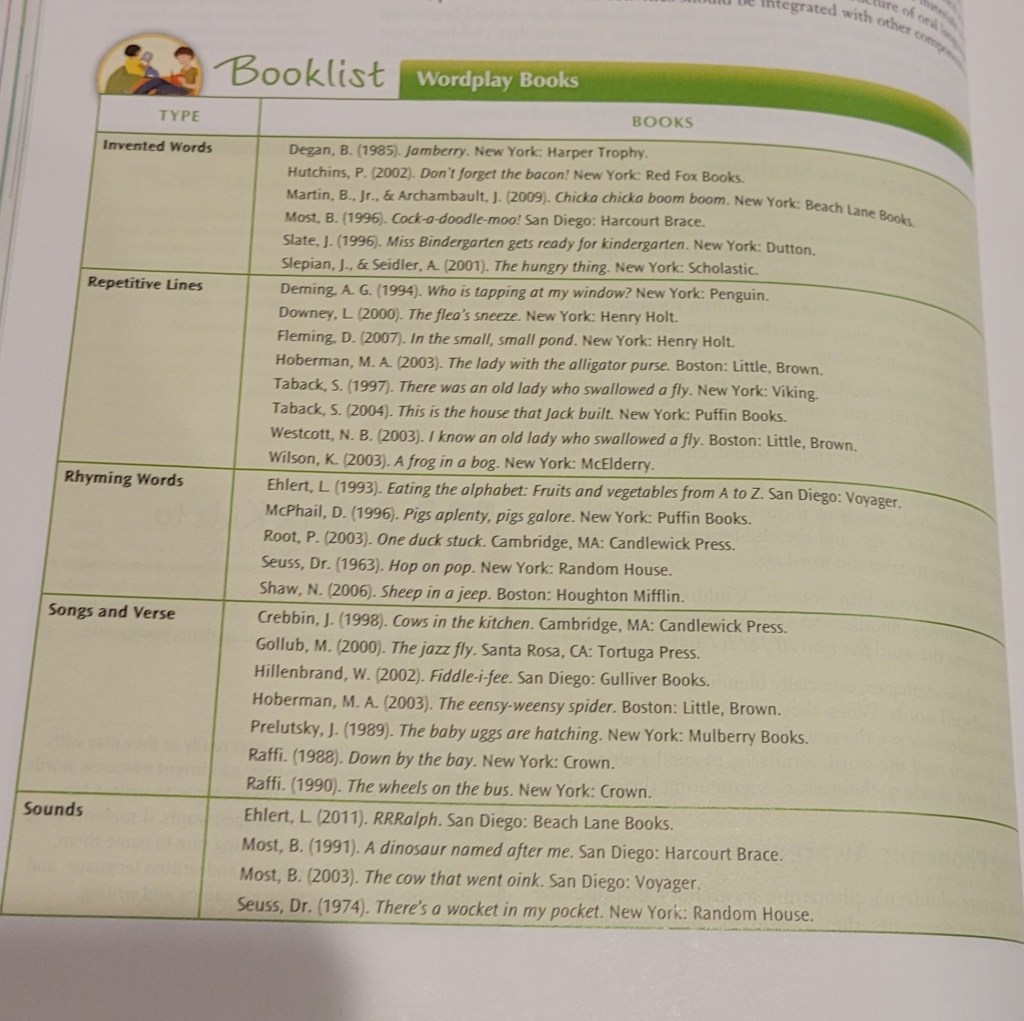
- These types of books will need to be read multiple times to the students for them to grasp the word play in them. The first time they hear the story, they will focus on the story. The second or third time they hear it, they will notice different word play throughout the story. Teachers can help to direct their attention to the word play in the story.
- Word play is a great thing for minilessons!
- Sound matching activities: For these types of activities, teachers will usually use words that the students are familiar with (Tompkins, 2017)
- Sound Matching Guessing Game: Teachers will prepare two containers with simple objects (ex. fork, watch, ball, hat). Each container will have the same type of objects in it. A student will choose an item out of the box and say the initial, medial, or ending sound. A second student will then grab the object out of the second box and hold it up. Classmates will then determine if the two objects are the same.
- Rhyming games are also great for this!
- Sound Isolation Activities: Teachers will say a word and the students will identify different phonemes in the word.
- Example: “Class, I am going to list three words and I want you to tell me what sound they all have that is the same. Chick, chuck, chain” Students would reply with /ch/.
- There can be simple songs tied into this type of activity to help students with recall of the concept.
- Sound Blending Activities: In this type of activity, teachers will somehow give students phonemes, and then have them put them together to form a word.
- Example: Puppet.. “only can speak in phonemes! C-a-t.” What word is our puppet friend saying? “CAT”
- If the teacher can tie these activities to a thematic unit that the class is working on, it helps with engagement and understanding.
- Sound Addition and Substitution Activities: Students will regularly substitute different sounds to form different words (both real and silly ones).
- A great example of this is in the song Old MacDonald Had a Farm by changing the sound at the beginning of “Ee-igh, Ee-igh, oh!” (Tompkins, 2017).
- Sound Segmentation Activity: One of the more difficult concepts for students to grasp. When a word is spoken, students are to break the word up or segment it into its sounds.
- To begin with, teachers may give a simple game like students clapping a couple of times with the beginning sound of a word, then saying the word.
- (clap) /t/ (clap) /t/ (clap) /t/ TURTLE!
- Teachers can add more segments to the game by using different types of games.
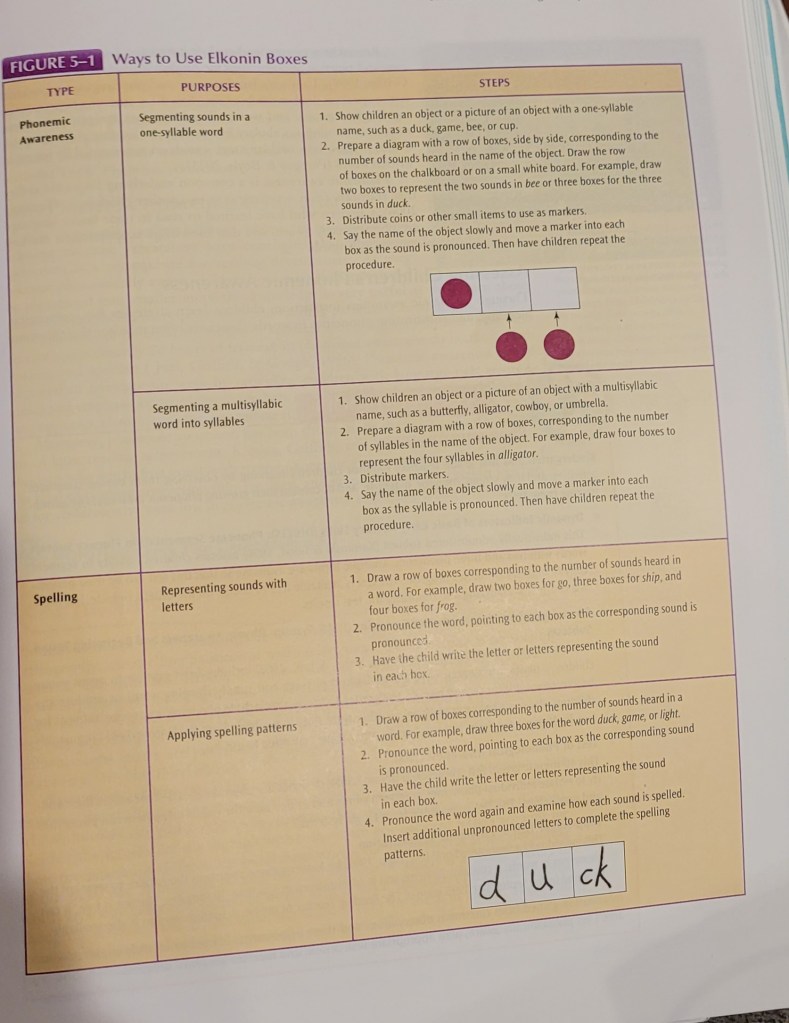
- Teachers also will use Elkonin boxes to help teach students to segment words. To do this, the teacher will show an object or a picture of an object and then draw a row of boxes (one box for each phoneme in the word). Then, the teacher, or the student, will move some sort of marker into the boxes as each segment of the word is said.
- Elkonin boxes can also be used for spelling activities
Tompkins, 2017, pg. 153
Nurturing English Learners:
- It can be more difficult to develop phonemic awareness for a student that is learning English, but it is still worthwhile if familiar words are being used.
- Teachers help ELLs by giving them a language rich environment. Teachers will read-aloud, sing songs, and use sayings and catch phrases with the class, and these are great for helping all students to learn and recognize different speech patterns in English.
- To be effective, teachers of ELLs need to be familiar with the student’s home language and understand how it differs from English.
- This is helpful in determining what sounds will be easier for ELLs to pronounce at first.
- Sounds that do not exist or are rarely used in the ELLs home language can be a lot more daunting for them (Tompkins, 2017).
- These students may need extra practice and time to learn these sounds as they have never experienced them before.
- Research shows that full integration of ELLs into English speaking classrooms is helpful in drawing their attention and helping them to understand English sounds and words.
- Remember: Children that are phonetically aware in their home language are fully capable of understanding different aspects of phonemic awareness in English. It just may take them a bit to transfer this knowledge from their home language to English.
Assessing Student’s Phonemic Awareness:
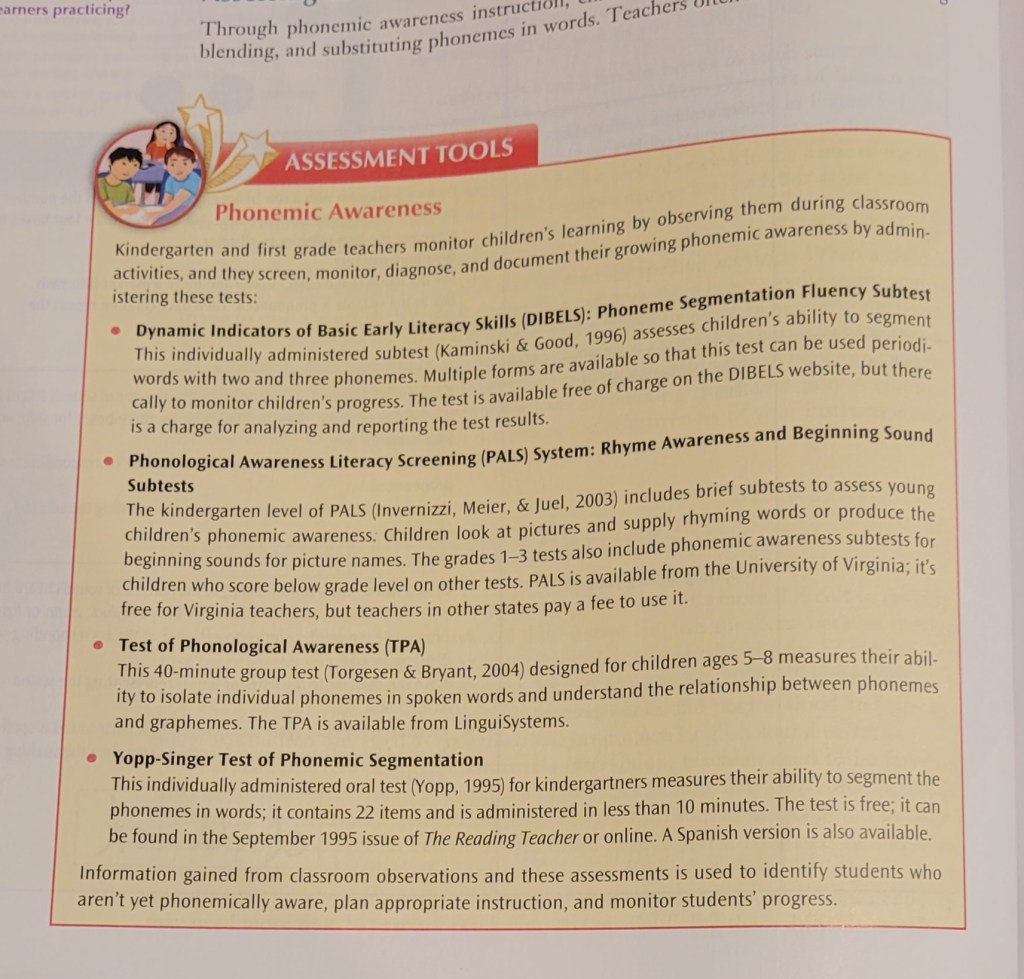
- During phonemic awareness instruction and activities, students learn to segment, blend, and substitute phonemes in words. Teachers will assess and monitor how students are doing with these skills as they do the activities. (formative assessment).
- There are also many different phonemic awareness tests to screen children’s abilities in phonemic awareness (Tompkins, 2017).
Tompkins, 2017, pg.154
Why is Phonemic Awareness Important:
- Evidence has shown that there is a clear connection between phonemic awareness and learning to read.
- Phonemic awareness has also been shown to “be the most powerful predictor of later reading achievement” (Tompkins, 2017, pg. 155)
Phonics
- Phonics is the set of relationships between phonology, the sounds in speech, and orthography, the spelling patterns of written language.
- The emphasis is on spelling patterns, not on the individual letters themselves as there is not a one-to-one correspondence between phonemes and graphemes in the English language.
- Phonemes can be spelled in different ways because of things like vowel placement or adjacent letters.
- Etymology: or language origin of words can also influence pronunciation.
- Some letters in words are not pronounced either (Tompkins, 2017).
- Often these “silent letters” exist because of the parent word that they came from, and are retained for semantic, not phonological, reasons.
Phonics Concepts
- Phonics explains the relationship between phonemes and graphemes.
- There are 44 phonemes in English that are represented by the 26 letters of the alphabet.
- The alphabetic principle suggests that there should be a one-to-one correspondence between phonemes and graphemes…. meaning that each sound is representative of only one letter.
- English is not a perfect phonetic language and there are over 500 ways to represent the 44 phonemes (Tompkins, 2017).
- Phonemes are classified as either consonants or vowels.
- Consonants: b, c, d, f, g, h, j, k, l, m, n, p, q, r, s, t, v, w, x, y, and z
- Most of these will represent only one sound, but there are a few exceptions:
- C can sound like cat or city.
- G, X, W, Y
- Two kinds of combination consonants are blends and digraphs
- Blends occur when two or three consonants appear next to each other in words and their individual phonemes blend together (ex. grass, belt, spring)
- Digraphs occur when there are letter combinations representing single sounds that aren’t represented by either letter.
- Common ones: ch, sh, th, wh, ph
- Vowels: a, e, I, o, u (sometimes y and w if they are in the middle and at the end of syllables and words)
- Vowels can be much more complicated than consonants because they can have many different sounds (Tompkins, 2017).
- Long vowel sounds are marked with a symbol called a breve
- Essentially the same as the letter names.
- Present in words like make, feet, bike, coal, rule
- Short vowel sounds are marked with a symbol called a macron
- Present in words like cat, bed, win, hot, cup
- Long vowel sounds are often spelled with two vowels except for if the long vowel is at the end of a one-syllable word
- When y is by itself at the end of a word, it is pronounced as a long e or long I (depending on the length of the word)
- Examples: baby, try
- Long vowel sounds are marked with a symbol called a breve
- Vowel sounds are much more complicated than consonants.
- Most vowel combinations are vowel digraphs or diphthongs.
- When two vowels represent a single sound, the combination is a vowel digraph (Examples: nail, snow)
- When two vowels represent a glide from one sound to another, the combination is called a diphthong (examples oi and oy)
- When one or more vowels in a word are followed by an r, it is called a r-controlled vowel because the r influences the pronunciation of the vowel sound.
- Single vowels with r are more predictable than the other types. The most consistent r-controlled vowels are ar as in car and shark and or as in fork and born.
- The other single vowel r combinations, er, ir, and ur are difficult to spell because they’re often pronounced like herd, father, girls, first, burn, and nurse (Tompkins, 2017).
- Three letter spelling of r-controlled vowels are more complicated. They include things like care, fear, here, roar, and your.
- These are particularly complex because they can be used in many different ways. Ex. Bears, beard, cleared, early, earth, bear, heart, learner, pear, pearls, spear, yearn.
- Blending Into Words: Readers blend or combine phonemes to decode words. Students must be able to identify phonemes and then blend those into a word.
- Long and short vowels can be a speed-bump in this process because students will get hung up on them until they fully understand the rules for long and short vowels.
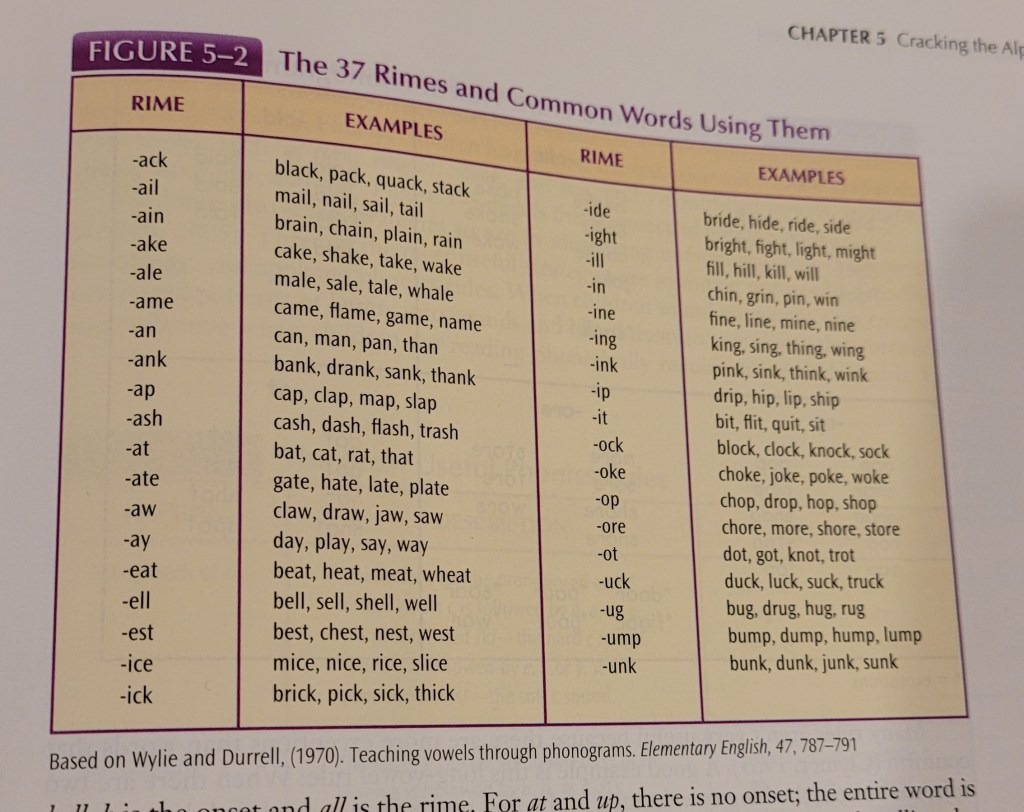
- Phonograms: One-syllable words and syllables in longer words can be broken into two parts, the onset and the rime.
- The onset is the consonant sound that precedes the vowel
- The rime is the vowel and any consonant sounds that follow it.
- Ex. Show, sh is the onset, ow is the rime
- For words like at and up there is no onset. The word is the rime.
Tompkins, 2017, pg. 159
- Teachers refer to rimes as phonograms or word families when they teach them.
- Beginning readers often read and write words using each phonogram but they must be familiar with consonant blends and digraphs to do this.
- Teachers will often post these word families on a word wall in the classroom.
- Teachers will use the words on the word wall in a variety of activities and students will refer to it to spell words when they are writing.
- Phonics Rules
- Because English doesn’t have a one-to-one correspondence between phonemes and graphemes, linguists have created rules to clarify English spelling patterns.
- One such rule is that q is followed by u and pronounced /kw/, as in queen, quick, and earthquake
- R influences the preceding vowels so that they’re neither long nor short (examples: car, wear, and four) but there are exceptions.. like the word fire
- There are other rules that were made that are not particularly useful because there are far too many exceptions.
- Only a few phonics rules have a high degree of usefulness and students should focus on learning the ones that they will actually use.
- CVC pattern rule: when a one-syllable word has only one vowel and the vowel comes between two consonants, it’s usually short, as in hat, land, and cup.
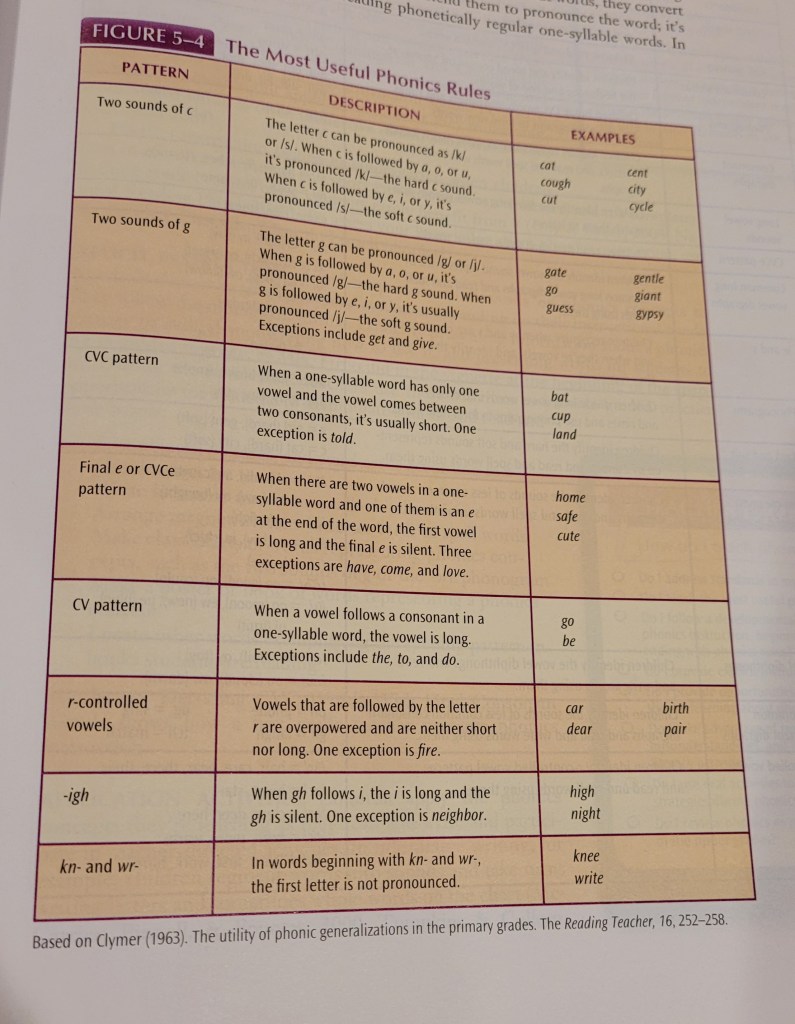
Tompkins, 2017, pg. 161
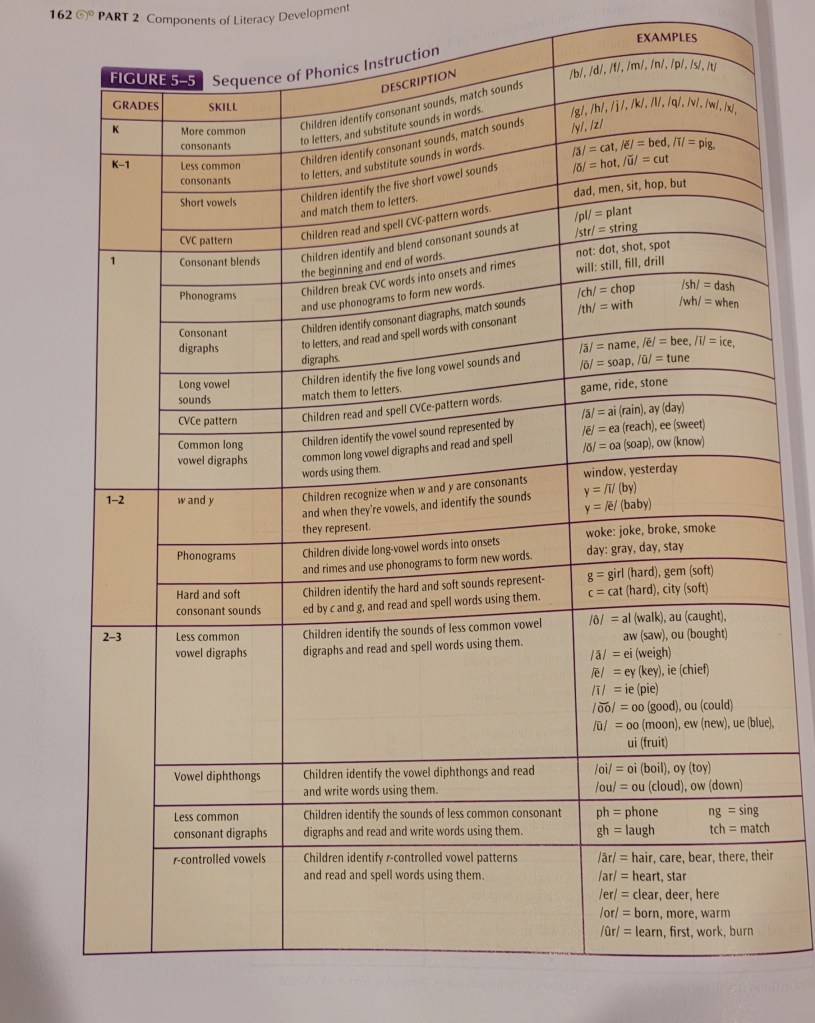
Tompkins, 2017, pg. 162
Explicit Instruction
- Teachers will use minilessons with either small groups or their whole class, to teach phonics concepts in greater depth.
- These minilessons will follow the same format as other minilessons: The teacher will begin by explicitly presenting information about a phonics strategy or skill, demonstrate how to use it, and present words for students to use in guided practice.
- Some examples of activities that teachers can use in minilessons to provide practice with phonics (Tompkins, 2017)
- Sort objects, pictures, and word cards according to a phonics concept
- Write letters or words on small whiteboards
- Arrange magnetic letters or letter cards to spell words
- Make class charts of words representing phonics concepts
- Make a poster or book of words representing a phonics concept
- Locate other words exemplifying the spelling pattern in books students are reading
Application Activities
- Students will apply the skills that they are learning as they read and write and participate in literary activities.
- In interactive-writing students will segment words into sounds and take turns writing letters and whole words on the chart
- Teachers help students to correct errors, and they find teachable moments to help review concepts with vowels and consonants.
- Making words and word sorts are some other activities
Assessing Students’ Phonics Knowledge
- Primary grade teachers assess children’s phonics knowledge using tests, observations, and reading and writing samples.
- Many will use a test at the beginning of the school year to assess where students are at with these skills, reassess them by testing again midyear, and document their achievement at the end of the year (Tompkins, 2017).
- If students are not meeting achievement goals or standards, teachers can test to diagnose the problem and plan for further instruction
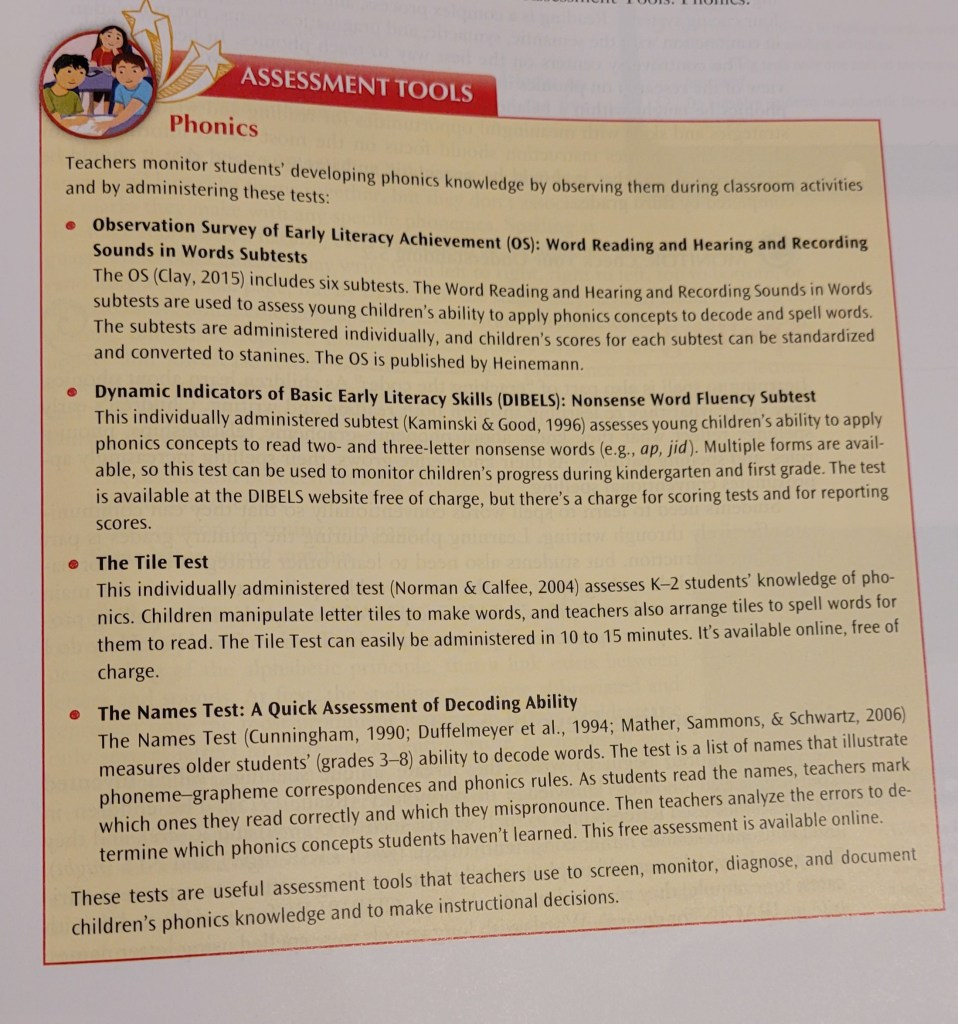
Tompkins, 2017, pg. 165
- Teachers observe students as they participate in activities and when they are reading and writing. These observations will show how they are applying the phonics strategies and skills they are learning.
- Students also show what they have learned during interactive writing, making words, and word sort activities.
The Role of Phonics in a Balanced Literacy Program
- Phonics is controversial.
- Some people believe that educational issues could be solved if children were taught to read using phonics (Tompkins, 2017)
- In truth though, reading is a complex process and the phonological system works with the semantic, syntactic, and pragmatic systems. Not on its own.
Spelling
- Children’s early spelling shows what they know about phoneme-grapheme relationships, phonics rules, and spelling patterns. As they learn more and more of these skills, their skills in spelling also increase.
- Students must learn how to spell conventionally so that they are able to communicate effectively.
- Phonics is an important part of this learning process, but there are other parts that are just as important!
Stages of Spelling Development
- When children are just beginning to write they will come up with unique spellings for things, these are called invented spellings and are based off the phonological knowledge they have.
- As students improve in spelling they go through 5 distinct stages
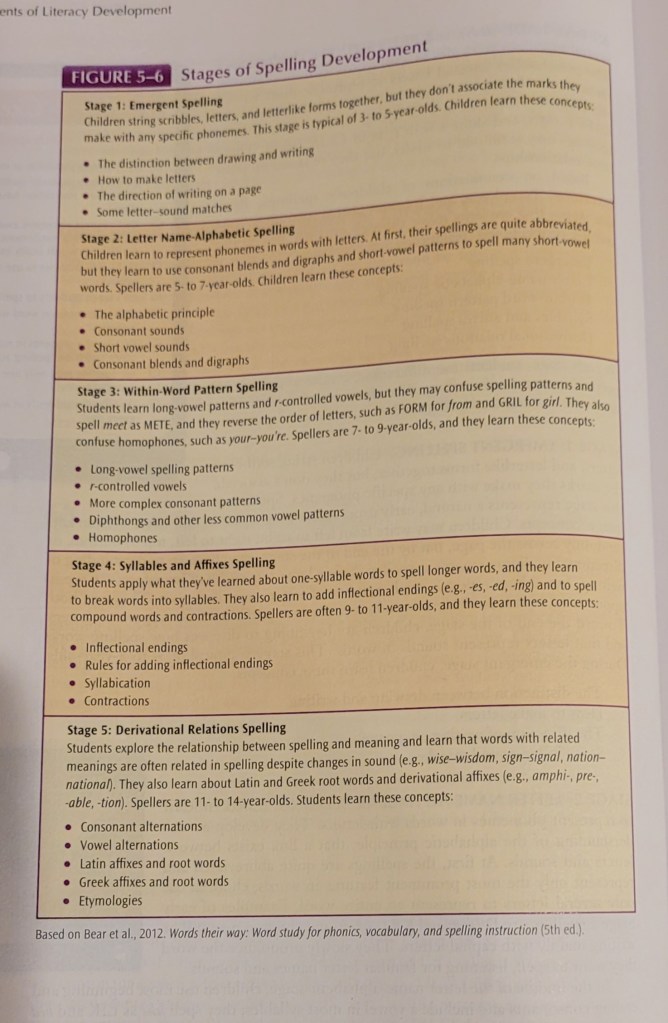
Tompkins, 2017, pg. 168
Teaching Spelling
- Perhaps the most common and best way to teach spelling is through weekly spelling tests. Tests should never be considered a complete spelling program.
- A complete spelling program will include:
- Teaching spelling strategies
- Matching instruction to students’ stage of spelling development
- Providing daily reading and writing opportunities
- Teaching students to spell high-frequency words
- When young children are trying to spell words, it can be more helpful to teach them a “Think-it-out” approach rather than a “Sound-it-out” approach.
- This approach reminds students that spelling involves more than phonological information and helps encourage their thinking about spelling patterns and root words (Tompkins, 2017)
- Teachers use two types of word walls in their classrooms
- One word wall features “important” words from books the class is reading or thematic units.
- The second type of word wall features high frequency words.
Classroom Applications:
Given that I want to teach in the early grade levels (somewhere between K-2) a great deal of what was in the chapter for this week directly applies to what I will be teaching my students! I have seen a lot of the concepts from this chapter demonstrated in classrooms over the past year and some are more effective than others. This week for example, in my PSTCE time, I got to observe students working on segmenting and blending words. The teacher I am observing had a lot of fun and creative ideas to keep the students engaged on this task. If I were to teach one of these early grade levels I would try to follow my supporting teacher’s example and include songs, rhymes, and games into my literacy block to add some fun to it.
I think these songs and games are also great because they give the students a level of consistency, and they know what to expect when their literacy block starts, which I feel is very important!
In my future classroom, I will also have a word wall to ensure that my students have that extra resource for spelling words that they may not have had a lot of practice using yet.
 Heather Owen : Reading and Language Arts Methods Notes
Leave a comment