Post 5: Heather Owen, EngEd 270, Chapter 4: The Youngest Readers and Writers
Vocabulary:
- Shared Reading: aninteractive reading experience where students join in or share the reading of a book or other text while guided and supported by a teacher. The teacher models the skills of proficient readers, including reading with fluency and expression.
- Interactive Writing: a dynamic instructional method where teachers and students work together to construct a meaningful text while discussing and working on the details of the writing process.
- Choral Reading: reading aloud in unison with a whole class or group of students. Choral reading helps build students’ fluency, self-confidence, and motivation.
- Word Wall: A display on a bulletin board or wall within the classroom designed to be an interactive tool for students. Contains words in large print that can be used during writing and reading.
- Minilessons: minilessons are concise, explicit lessons with a purposeful application in building your students’ independent reading competencies or writing competencies.
- Interactive Read-Aloud: Interactive read-aloud is a whole-group instructional context in which you read aloud a selected text to the whole class, occasionally and selectively pausing for conversation. Students think about, talk about, and respond to the text as a whole group or in small groups.
- Grand Conversation: a student-led whole-class discussion around a specific topic that the students are reading about or writing about.
- Phonology: Children learning to produce the sounds of English and how to manipulate them in playful ways.
- Syntax: Children learn to combine words into different types of sentences and to use irregular verb forms, pronouns, and plural markers and other inflectional endings.
- Semantics: Children acquire knowledge about the meanings of words and add several thousand words to their vocabularies each year.
- Pragmatics: Children learn to use language socially- to carry on a conversation, tell stories, and use social conventions, including “please” and “thank you”.
- Story Retellings: Retelling is the process of recalling the events that happened in a story in order from the beginning, middle, to end. Retelling is used to promote comprehension, which is the process of understanding what is being read and building on the information learned by connecting it with other stories or real-life events.
- Story Boards: Storyboards are simple tools any student writer can use to create a story or organize information. A storyboard is an illustrated outline where a student can draw their ideas, write their ideas, or both. A storyboard is usually a single page with boxes that flow in a logical order.
- Basic Interpersonal Communicative Skills (BICS): refers to a student’s ability to understand basic conversational English, sometimes called social language. At this level of proficiency, students are able to understand face-to-face social interactions and can converse in everyday social contexts.
- Cognitive Academic Language Proficiency (CALP): focuses on proficiency in academic language or language used in the classroom in the various content areas. Academic language is characterized by being abstract, context reduced, and specialized.
- Revising Groups: Small or large groups within the classroom that work on revision of pieces of writing. Students will work together to learn and perfect their writing talents.
- Language Experience Approach: this approach integrates speaking and listening, reading and writing through the development of a written text based on firsthand experiences.
- Collaborative Books: Collaborative literacy can be simply defined as the use of multiple strategies to engage the readers in a group setting.
Source:
Tompkins, G. E. (2017). Literacy for the 21st Century: A balanced approach. Pearson.
Key Concepts:
- Three important developmental stages throughout literacy to remember:
- Emergent
- Beginning
- Fluent
- Shared reading is an opportunity to work with readers on all levels of the developmental stages:
- As students see teachers modeling various aspects of reading, these early emergent readers are learning literary skills that will be crucial to their success as readers and writers later.
- Beginning readers will benefit from experiences in the classroom where they get practice identifying sight words and decoding CVC words. During this, teachers also help them to note different textual elements that are important to reading and writing, like sentence structure and punctuation.
- Fluent readers can be challenged at the same time, using the same books as emergent or beginning readers. Throughout the reading allow these fluent readers to identify adjectives, verbs, or the use of forms of punctuation.
Some examples of literacy centers:
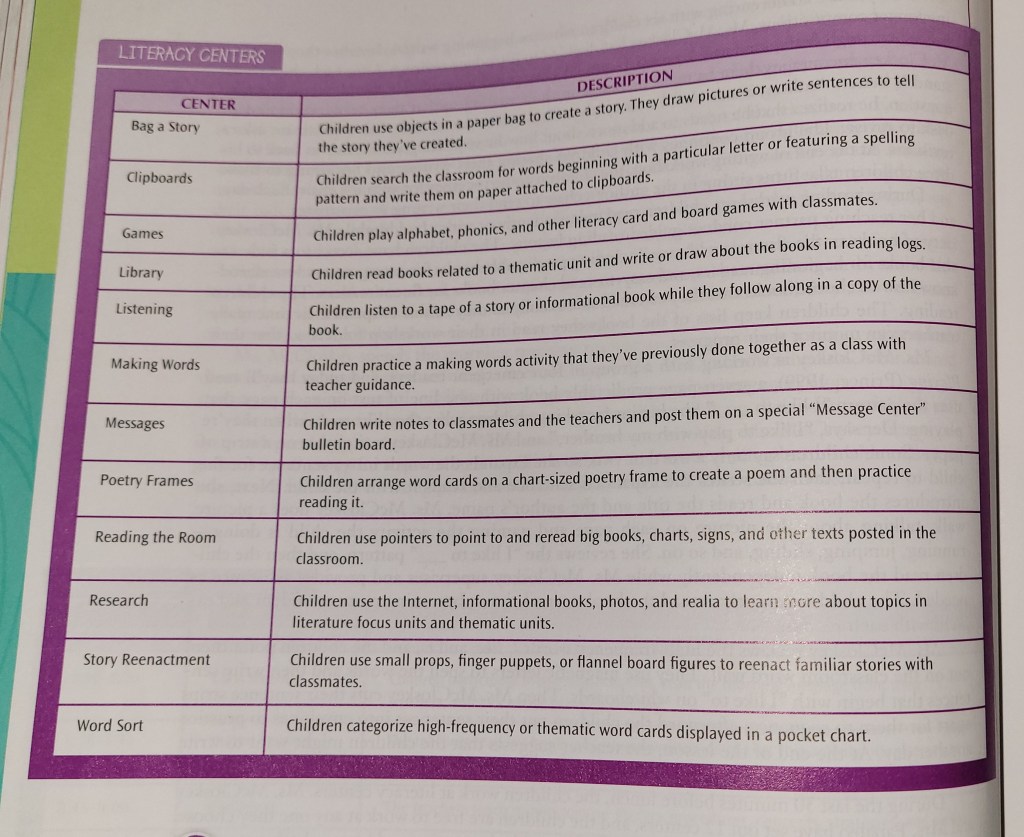
- Remember, literacy is a lifelong process! It begins in infancy and continues through adulthood.
- It used to be believed that children wouldn’t be able to read competently until they were in first grade, but over time this theory has been discredited as it has been discovered that students in preschool have even been able to figure out the early concepts of reading, or even teach themselves to read!
- This perspective on how children become literate (learn to read and write) is known as emergent literacy (Tompkins, 2017).
Nurturing Children’s Oral Language Development
- Young children develop their oral language through everyday experiences and interactions with others (parents, adults, other children).
- They learn different words as they collect things, participate in family activities, or play with friends
- They learn even more when they are regularly read to or watch programs that are aimed at the educational and emotional needs of young children.
- Through these life activities, students gain knowledge in all four language modes:
- Phonology: children learn to produce the sounds of English and to manipulate them in playful ways
- Syntax: Children learn to combine words into different types of sentences and to use irregular verb forms, pronouns, and plural markers and other inflectional endings.
- Children acquire knowledge about the meanings of words and add several thousand words to their vocabularies each year.
- Children learn to use language socially- to carry on conversations or tell stories. They also use social conventions like “please” and “thank you”(Tompkins, 2017).
- By the age of five, children will have acquired the oral language of their home culture.
- Oral Language Activities:
- After the age of five, children will continue to grow their abilities in language at school, particularly through literacy activities.
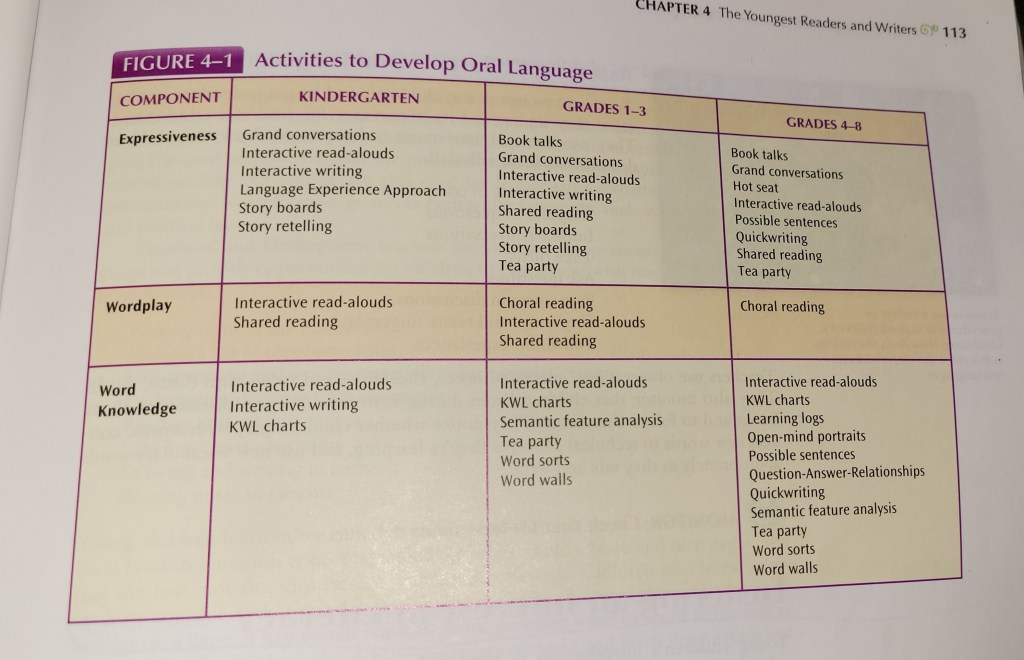
- One of the most useful of these is interactive read-aloud. During this practice, children will listen and learn new vocabulary and learn about sentence structure.
- After the age of five, children will continue to grow their abilities in language at school, particularly through literacy activities.
Some great books to use to develop oral language:
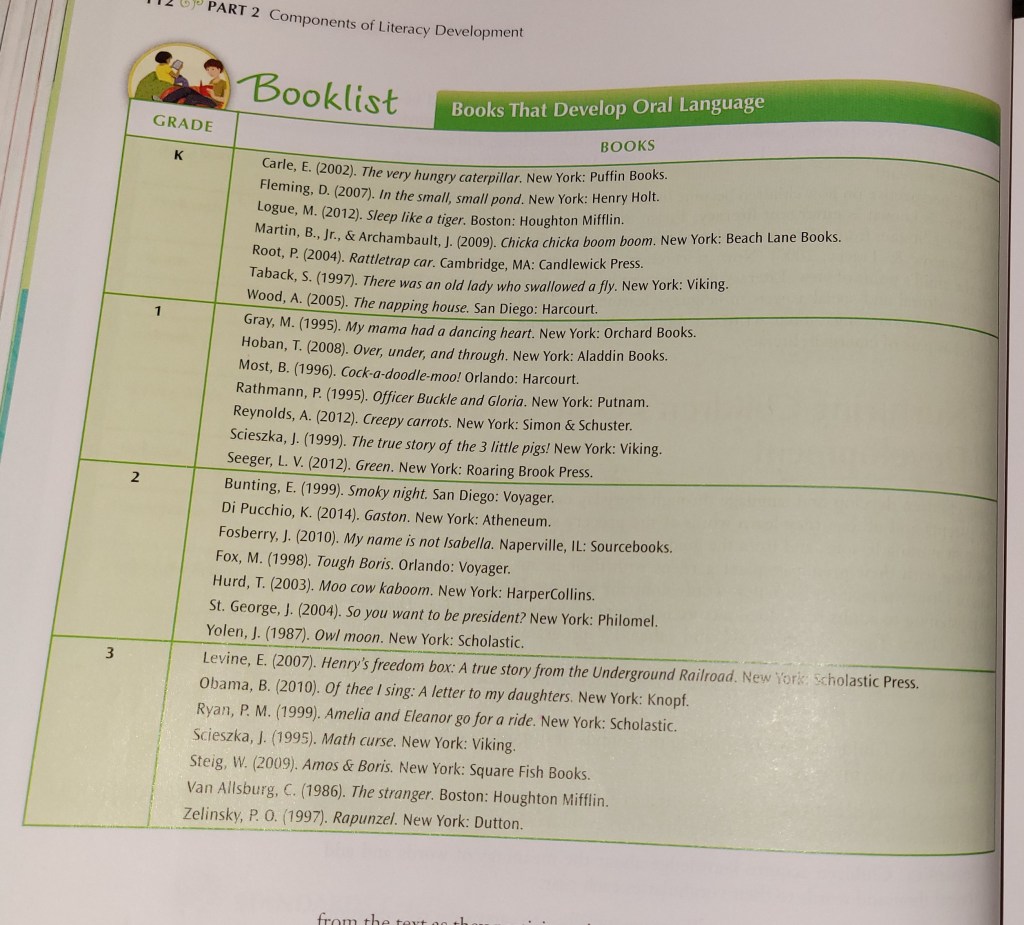
- After participating in an interactive read-aloud, students can participate in related literacy activities like grand conversations, story retellings, or use story boards to put events from the story into order.
Some activities that can be used to help develop oral language
- Learning a Second Language:
- Remember that learning a second language is a process much like learning a language the first time… it is a process and will have to happen in stages.
- Students will learn language best in an environment with good models of proper language use (teachers, and other students), and from being encouraged to talk in the classroom setting.
- Children acquire conversational English skills, known as Basic Interpersonal Communicative Skills or BICS in about two years or less, but academic English, known as Cognitive Academic Language Proficiency or CALP can take 7 or 8 years to acquire.
- This is important to note, because while students in 3rd or 4th grade may seem to be fluent in English, they may still struggle with academic language.
- There are many societal and cultural factors that will influence student’s abilities to acquire these language skills.
- A child’s personality
- The attitudes of their cultural group
- And teacher expectations
- All of these are prime examples of things that can influence how and when students learn different language skills.
- Students who continue of develop their proficiency in their first language tend to continue to develop well in learning English compared to students that do not still work on their first language skills.
- The Link Between Oral Language and Literacy
- Developing children’s oral language is essential because it provides the foundation for literacy learning.
- Students that do not develop strong oral language before first grade have difficulty keeping pace with their classmates. This is extremely important to keep in mind when working with the youngest readers. Their success in this area is incredibly important.
- Research has shown that students who have capabilities to orally define words typically are more easily able to gain literacy knowledge.
- Other things that could affect how quickly or easily a student picks up reading and other literacy skills are things like phonemic awareness, and letter knowledge.
- These are important to students being able to read, but they do not aid comprehension.
- Assessing Children’s Oral Language:
- Monitoring the advancement of children’s oral language skills is important to the academic success of these children.
- With the youngest readers and writers, teachers will watch for the following skills:
- Speaking clearly and in complete sentences
- Responding to questions
- Initiating conversations
- Taking turns when talking
- Asking questions
- Participating in discussions
- Sing songs and recite fingerplays
- Tell stories about experiences(Tompkins, 2017)
- Fostering an Interest in Literacy:
- Students learn about literacy and written language before they come into a school setting.
- Parents may read books to them, they may notice signs and writing in stores, or on drives in the car.
- Some have had their parents write things out for them, and some have had the opportunity to practice writing with a writing utensil of some kind- and while they don’t understand word or letter forms yet, it is instilling basic skills that will be needed later on once the child is in school.
- When these children come to school, their knowledge of language expands very quickly as they have more and more meaningful experiences with writing and reading (Tompkins, 2017).
- Common Core State Standards for ELA emphasize the importance of fostering a child’s interest in reading and writing.
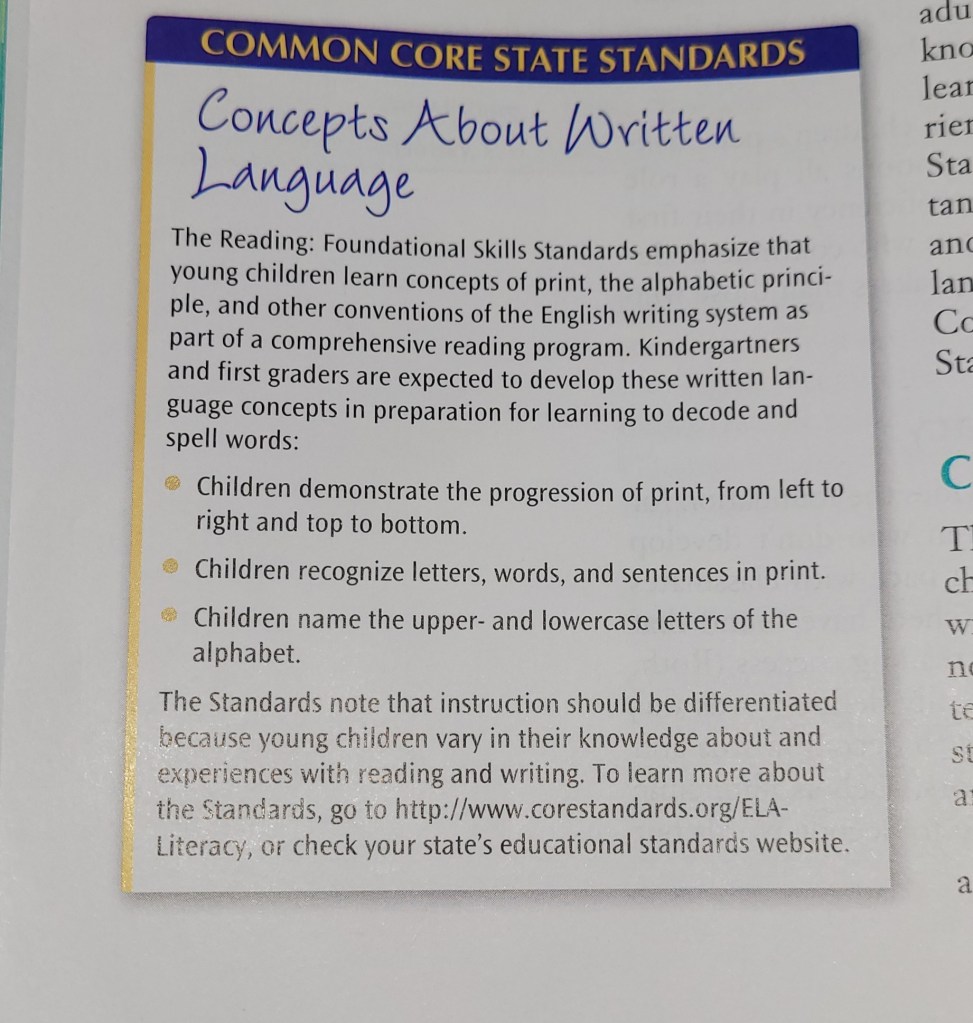
- Concepts About Print:
- Through experiences at home and in their classrooms, students learn that print carries meaning and that reading, and writing are useful for many different things.
- Children are amazing observers and will take note of different forms of print that they find throughout their daily lives (menus, postcards, letters, magazines, etc.)
- Reading and writing are a part of daily life for almost every family, but families vary how they use written language.
- Some families in different academic situations will have different experiences that they give to their children.
- For some communities writing is usually only used for bills or more technical things. In others, writing is more of a leisure activity.
- Preschool and Kindergarten teachers demonstrate the purposes of written language and provide opportunities for children to experiment with reading and writing in many ways such as:
- Posting signs in the classroom
- Making a list of classroom rules
- Using reading and writing materials in literacy play centers
- Exchanging messages with classmates
- Reading and writing stories
- Labeling classroom items
- Drawing and writing in journals
- Writing notes to parents (Tompkins, 2017)
- Students are introduced to many print concepts in these early grades as well.
- Directionality of print
- Book parts and concepts
- Matching voice to print
- Learning about punctuation
- Concepts About Words:
- There are four stages of word consciousness
- At first, children don’t differentiate between words and things
- They begin to describe words as labels for things and begin to understand that names for things are words
- Children begin to understand that words carry meaning and that stories are built from words
- More fluent readers and writers describe words as autonomous elements having meanings of their own with definite semantic and syntactic relationships.
- Children develop concepts about words through active participation in literacy activities.
- They may participate in shared reading. During this they will mimic the teacher pointing to words as the reread familiar texts. After many of these shared experiences, students will begin to notice things like word boundaries and the spaces these are made from, and will pick out familiar words.
- As they continue to practice they will become better and better at identifying things like the beginning and end of a sentence.
- There are four stages of word consciousness
- Environmental Print:
- Young children begin reading by recognizing things like logos, or the names of commonly used items.
- At this point, the children rely on context to understand and recognize familiar words and memorized text. As they get more and more practice however, they will begin to make connections without the need of clear context.
- Writing:
- As mentioned previously in the chapter notes, children will not write letters right away when they first begin learning to write. They will instead start with scribbles and letterlike shapes.
- As they gain more understanding of letters and phonemes/graphemes they can begin to write three letter words. Usually when they are beginning to write these short words, they will have all of their words run together. Over time, as they experience more literacy activities and see more print, they will begin to use spaces for word boundaries.
- At this time they will also take note of the importance of capitalization as a beginning point of a sentence.
- They will also begin to understand and recognize that sentences usually end with punctuation and this will start with a period.
- Literacy Play Centers:
- Children also develop concepts about the alphabet and how letters are used to represent phonemes.
- Pinnell and Fountas identified these components of letter knowledge.
- The letter’s name
- The formation of the letter in upper and lowercase manuscript handwriting
- The features of the letter that distinguish it from other letters
- The direction the letter must be turned to distinguish it from other letters (ex. b and d)
- The use of the letter in known words
- The sound of the letter by itself
- The sound of the letter in combination with other letters
- The sound the letter represents in the context of a word (Tompkins, 2017)
- As children learn these components, they use them to decode unfamiliar words while reading, or spell words as they are writing.
- The first step in the process is identifying letter names and their forms in handwriting.
- Typically, most kindergarten students can identify some letters
- They also usually can write some familiar letters.
- Research suggests that children do not learn letter names in any particular order or by isolating letters from meaningful written language in skill-and-drill activities.
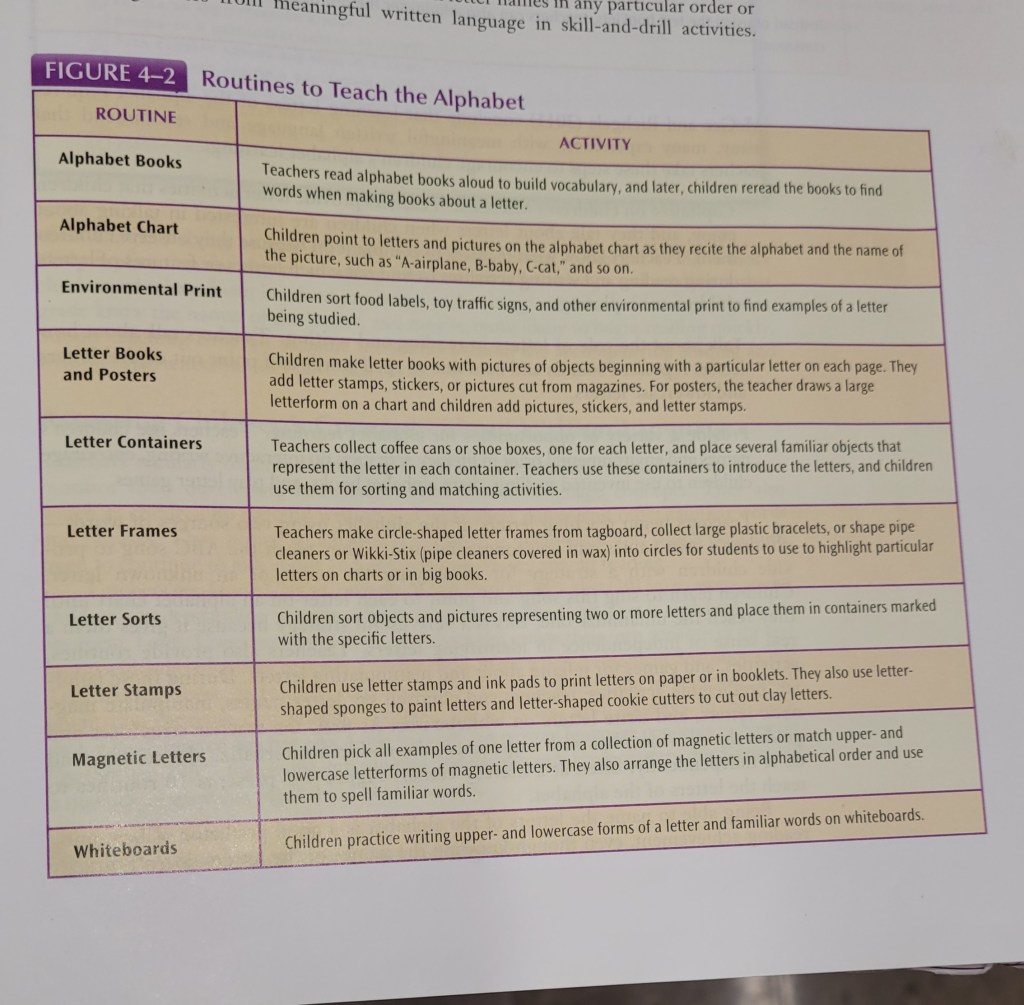
- Some research suggests that learning letters of the alphabet requires many experiences with meaningful written language and recommend that teachers take these steps to encourage children’s learning of the alphabet:
- Capitalize on children’s interests: provide letter activities that the children enjoy.
- Talk about the role of letters in reading and writing: Teachers talk about how letters make sounds and combine to form words and point out the differences of capital and lowercase letters.
- Provide a variety of opportunities for alphabet learning: Teachers use a variety of different tasks to help students to learn. These can include having their name on their desk written out, interactive writing, playing letter games, or sharing of alphabet books.
- Teachers begin teaching letters of the alphabet using two sources of words: typically children’s own names and environmental print.
- Teachers also teach student the ABC song and use posters or pictures of the letters to help students to build a familiarity with these letters. Students learn that the ABC song can be useful in helping them to identify a letter that is unfamiliar to them.
- Teachers also provide games, activities, and talk about letters and give the students chances to practice manipulating them.
- During these activities students may practice tracing letters, saying letter names, using magnetic letters, or writing on white boards.
- At first, in this learning process, the teacher guides every step of the process. But as routines develop, students eventually can do these activities with little to no guidance.
- Students may be on a path to reading if they learn their letters while also having a solid connection between letters and books. If this relationship is not made, students may take a little longer to read.
- Assessing Children’s Concepts about Written Language
- Teachers will regularly observe students as they read to assess their abilities with different literacy skills
- Teachers can use Marie Clay’s Concepts About Print Test to assess student’s understanding of written language concepts. This CAP Test helps to give teachers a snapshot of how readers are doing with their understanding of different elements of print.
- How Children Develop as Readers and Writers
- There are three typical stages that children go through when learning to read: emergent, beginning, and fluent.
- During the emergent stage:
- Students develop an interest in reading and writing
- Students acquire concepts about print (like what different parts of a book they might see)
- Students develop book handling skills (how can I care for a book?)
- Learn to identify the letters of the alphabet
- Develop their handwriting skills
- Learn to read and write some high frequency words (Tompkins, 2017)
- Most students are emergent readers until they gain different reading experiences and skills in kindergarten, but sometimes students who read at home regularly may become readers earlier than kindergarten.
- During the beginning stage of reading:
- Students gain more and more awareness about alphabet principles.
- They also learn about graphemes and phonemes and how these create words.
- Before the completion of this stage, students will be able to:
- Learn phonics skills
- Recognize 100 high frequency words
- Apply reading strategies (like: cross-checking, predicting, and repairing).
- Write five or more sentences, sometimes organized into a paragraph.
- Spell phonetically
- Spell 50 high frequency words
- Use capital letters to begin sentences
- Use punctuation marks to signal the end of a sentence
- Reread their writing (Tompkins, 2017).
- Typically, first and second graders will be the ones that are working through this stage of reading
- Children in this stage will read slowly, in a word-by-word fashion, stopping often to sound out new or unfamiliar words.
- Near the end of this phase, student will go from writing one or two sentences to being able to write paragraphs!
- During this phase and the earlier phase, teachers will use things like interactive writing, choral reading, and mini lessons to help scaffold the student’s learning.
- It is important to remember that writing takes time, practice, and scaffolding, much like reading goes. Students do not start writing rough drafts when they first begin writing: rather they work up to this by practicing sentences and word form.
- During the fluent stage of reading: fluent readers will be able to recognize hundreds and hundreds of words automatically and use skills they’ve developed to identify words and phrases that they don’t understand.
- Fluent writers will understand how to write a rough draft, revise a draft, and then use those revisions to make a final draft.
- They will also participate in revision groups to get used to taking and receiving critiques from many different people to help perfect their writing craft.
- Fluent readers and writers will be able to accomplish the following:
- Read fluently with expression
- Recognize most one-syllable words automatically and can decode other words efficiently
- Use decoding and comprehension strategies effectively
- Write well-developed, multi-paragraph compositions
- Use the writing process to draft and refine their writing
- Write stories, reports, letters, and other genres
- Spell most high-frequency and other one-syllable words correctly
- Use capital letters and punctuation marks correctly most of the time (Tompkins, 2017).
- Some second-grade students will reach this phase and it is the goal that all students should be fluent readers and writers by the end of third grade.
- This milestone is particularly important because it means that these children will be better equipped to handle the more intensive writing requirements of fourth grade and beyond.
- The distinguishing characteristic of fluent readers is that they can read words accurately, rapidly, and expressively.
- Their reading rate is at least 100 words per minute, and more importantly, they can vary the speed at which they read to match the difficulty of the text they are to read.
- Students that are fluent readers tend to read silently or to themselves because they can read more quickly silently than aloud.
- Their comprehension skills are stronger and they are able to read a lot more content than a beginning reader could.
- Fluent writers understand that writing is a process, and they use the different stages of writing including prewriting, drafting, revising, editing, and publishing.
- Instructional Practices:
- Teachers who work with the youngest readers and writers use many of the same instructional strategies that teachers with older students do. These can be things like reading aloud, doing guided reading with leveled books, teaching from basal readers, and providing opportunities for independent reading and writing through workshops.
- Teachers will adapt these strategies to fit the specific needs of their students.
- Morning Message:
- This is a great literacy strategy that teachers can use to get the day started on the right food with literary skills (Tompkins, 2017).
- Before students arrive for the day, the teacher will write a brief message on chart paper or on the board (often in the form of a letter) that details some of the things that students will do throughout the day.
- Teachers will choose words for their morning message that most of their students should know or be able to decode.
- Teachers will also try to follow a consistent pattern with their messages from day to day so that the students can get more and more skilled with reading them.
- An example could be: “Good morning class, Today is Monday. We will plant seeds. We will make books about plants. We will sing about plants. Love, Mrs. Owen”
- As students go into second or third grade, the messages become more complex.
- Some ways that this could be adapted for different classrooms: Fill-In-The-Blank style morning message. This gives the students practice with their word choice and how to write sentences that make sense.
- Another way is one student could dictate a message to share with classmates. They could then read their messages aloud to their classmates, pointing to each word as they read it.
- One final way that this could be adapted is by allowing the students to create a collaborative message. At the end of a school day the class could work together to write some sentences about what they did that day.
- Shared Reading
- Teachers use shared reading to read books aloud that are developmentally appropriate for children in their class. Whether or not a book is appropriate can be determined by looking at the interest level that the children will have and the difficulty level of the text.
- While using shared reading in a classroom, teachers use the five stages of the reading process.
- Through the reading process teachers model what fluent readers will do by involving children in enjoyable activities (Tompkins, 2017).
- The books that are typically used for shared reading are close to a child’s reading level, but still beyond their ability to read independently.
- Shared reading as an instructional strategy differs from interactive read-alouds because children see the text as the teacher reads the story to them.
- They will join the reading during parts that are predictable or where there is a lot of rhyming.
- Once the teacher has read the text to students multiple times, they begin to remember the story well enough that they can read along with the teacher.
- As students become more and more familiar with a text they may find a familiar portion and start the students on it, but then allow them to finish familiar statements without the teacher.
- Predictable Books: books with repeated sentences, rhyme, or other patterns. There are four common types of these patterns:
- Repetition: Authors repeat sentences to create a predictable pattern within picture books.
- Cumulative Sequence: Sentences are repeated and expanded in each episode in these books.
- Rhyme and Rhythm: These are two poetic devices that authors use to add a musical quality to their writing. (Think Dr. Seuss). The sentences in these types of books have a strong beat, and rhyme is used at the end of the lines typically.
- Sequential Patterns: Some authors will use a familiar sequence in their story, like months of the year, days of the week, or numbers to structure their books (Tompkins, 2017).
- Language Experience Approach (LEA):
- Based on children’s language and experiences
- Using this approach, teachers do shared writing, children dictate words and sentences about their experiences, and the teacher writes down what the children say.
- This text becomes the reading material. Because of the way this text was created and because it is based on the experiences of the children themselves, it is usually something they are able to read easily.
- This approach links reading and writing together because they are reading what they have written as a group.
- Using this approach, students create individual booklets. They draw pictures on each page or add in photos from magazines.
- They then have their teacher write for them as they dictate what should be written to go with the pictures.
- Children can also make collaborative books where they each get to take turns with pages, illustrations, and parts of the story.
- An important note…. When taking dictation, it’s a great temptation to change the child’s language to the teacher’s own to help with word choice or grammar. But editing should be kept at a minimum so that children do not get the impression that their writing is not good enough.
- Interactive Writing:
- Children and the teacher create a text together during interactive writing.
- Typically this is done on chart paper.
- The teacher will guide them as they take turns writing the text, word by word. All the students in the class will participate in this writing style.
- This writing style allows students to learn concepts about print, letter-sound relationships, spelling patterns, handwriting, and other things like capitalization and punctuation mechanics. Throughout the writing, teachers model things like conventions and students learn about segmenting words.
- Throughout this, teachers ensure that students don’t lose confidence it they make a mistake. Teachers should try their best to teach students that spelling is an important courtesy to readers, not that they are ‘not smart’ if they make a mistake in their spelling.
- This is a point when word walls are incredibly helpful (Tompkins, 2017).
- Manuscript Handwriting:
- When students enter kindergarten, they may have a variety of experiences in the classroom. Some may have written a lot in preschool, others may never have held a pencil for writing before.
- Kindergarten focuses on things like handwriting, fine-motor control, how to hold a pencil properly.
- Some people may argue that kindergarten is too early for people to be worried about students writing skills, but in reality, student’s should be encouraged to write as early as possible.
- The more they write the greater their need becomes for instruction in handwriting. Instruction is necessary so that children do not learn bad writing habits that later must be broken.
- Researchers recommend that students watch teachers to see how letters are formed and then practice forming them themselves. They believe that this is far more effective than work sheets. Learning in this way teaches them good habits that will help make their transition to writing cursive later on, much smoother (Tompkins, 2017).
- When students enter kindergarten, they may have a variety of experiences in the classroom. Some may have written a lot in preschool, others may never have held a pencil for writing before.
- Writing Centers:
- These centers are set up in kindergarten and first grade classrooms so children have special opportunities to write.
- Centers should be at a table with chairs and include pencils, crayons, a date stamp, different kinds of paper, journal notebooks, a stapler, blank books, notepaper, and envelopes.
- Also ensure that the upper and lower case alphabet are visible somewhere on the table so they can refer to them as they write. There should also be a crate nearby where students can file their work.
- At these centers students can draw, write in journals, compile books or write messages to family members or classmates. The teacher or other assistants will help the students with letters, words, spelling or other concepts as needed.
- Through these activities, students learn different writing skills and gain writing confidence. This type of center helps children to discover the social purposes of reading and writing.
Source:
Tompkins, G. E. (2017). Literacy for the 21st Century: A balanced approach. Pearson.
Viewing for Week 6
Becoming Aware of Print
It is important to be aware of how children become aware of print. It starts as early as infanthood. Reading researchers recommend that parents attempt to point out print as early as they can and explain to their child how it is used. Regular, repeated use of print in their lives will help them to develop a positive relationship with text from their beginning.
wetalearningmedia. (2008, May 19). Becoming aware of print. YouTube. Retrieved October 18, 2022, from https://www.youtube.com/watch?v=2Yti78OGxg0&ab_channel=ReadingRockets
Concepts About Print Observation Test
In this video, we were able to see a recording of a CAP observation test as it was happening. Throughout the test, the proctor or teacher was able to ask the students about different elements of the text, like “where is the front cover?” or “what direction should you read?” As the student seems to grasp certain concepts, the teacher is able to ask more complex questions, like “where is the first word on the page, where is the last word on the page?”
YouTube. (2014, March 7). Concepts about print observation test. YouTube. Retrieved October 18, 2022, from https://www.youtube.com/watch?v=nKo2cLJjZMU&ab_channel=JenniFrancis
Concept of Print
This video explains in greater detail the different concepts of print that would be covered in a CAP observation test.
shannygar. (2013, December 10). Concept of print. YouTube. Retrieved October 18, 2022, from https://www.youtube.com/watch?v=h1l9pZSDTiM&ab_channel=shannygar
Classroom Applications:
In my future classroom there are a lot of components from this chapter that I would like to implement. For starters, I really loved the idea of writing centers. I think that these would be useful in grades above K and 1, as long as the concepts are a tad more complex. I see benefits to something like this with the 2nd and 3rd grade students that I am working with this year.
For some of the students, writing can be a painful experience. These students are not particularly strong readers typically- and because of this, writing is a struggle. Centers like this help to encourage the student’s creativity and allow them a chance to explore and test different writing ideas that they may not have felt comfortable trying in an average writing assignment. I think it helps to get the students more excited and more engaged in the writing process.
 Heather Owen : Reading and Language Arts Methods Notes
Leave a comment