Post 4: Heather Owen, EngEd 270, Chapter 3: Assessing Literacy Development
Vocabulary:
- Running Records: an assessment tool which provides an insight into a student’s reading as it is happening. A Running Record provides information on the following: a score of word reading accuracy. an analysis of a reader’s errors and self-corrections. an analysis of the reading strategies used.
- Assessment: formative, ongoing. Provides immediate feedback to improve teaching and learning. Authentic and based on the literacy activities that students are already engaged in.
- Evaluation: summative, and final. Typically administered at the end of a unit or a school year to judge quality of learning and teaching.
- Book talk: a short (30 second – 2 minute) speech designed to encourage someone to read a book, giving an idea of plot, characters, or themes of the book, but, unlike a book report, does not summarize the whole plot or give away the ending or major plot points. Should get people excited to read the book!
- Rubrics: A.k.a. Scoring Guides. Used to evaluate student performance according to specific criteria and levels of achievement. They describe specific criteria and levels of achievement for students.
- Informal Reading Inventories (IRIs): Commercial tests. Used to evaluate students’ reading performance. Can be used for first grade through eighth grade.
- KWL Chart: an acronym for Know, Want-to-know, and Learned, KWL is an effective way to read with purpose. KWL is easy to apply and can lead to significant improvement in your ability to learn efficiently and to retain what you have learned.
- Revising Groups: Groups where students work together to revise their piece of writing together.
- Minilessons: A mini lesson is a short 10 minute whole group lesson that takes place during reading workshop. It has just ONE clear objective. During your mini lesson you are teaching your students just one reading strategy or skill they can apply to their independent reading or writing.
- Question-Answer Relationships: Teaching students about these can prove helpful for them to understand that sometimes answers to test questions can be found in a passage that they’ve just read, or they may have to use their own knowledge.
Source:
Tompkins, G. E. (2017). Literacy for the 21st Century: A balanced approach. Pearson.
Key Concepts
- Over the years, school district, state, and federal education agencies have increased their demands for accountability.
- Today, most students take annual standardized (high-stakes) test to measure their achievement.
- These assessments provide the teachers with valuable information and help teachers to make instructional decisions.
- Linking both assessment and instruction improve students’ learning and the teaching the teacher provides.
- Assessment and evaluation are often used interchangeably but they are not interchangeable.
- Assessment: formative, ongoing. Provides immediate feedback to improve teaching and learning. Authentic and based on the literacy activities that students are already engaged in.
- Evaluation: summative, and final. Typically administered at the end of a unit or a school year to judge quality of learning and teaching.
- Tests are typically the most common type of evaluation and they’re used to compare one student’s achievement against that of other students or against grade-level standards.
- Classroom Assessment: drives instruction, ensures that students are making adequate progress, determines the effectiveness of instruction, and documents students’ achievement.
- Teachers use a combination of assessment tools to collect information about where their students are at with their learning.
- Assessment involved four steps….
- Planning
- Teachers plan for assessment at the same time that they are planning instruction. They think about questions like:
- Do students have background knowledge and vocabulary on the topic to be taught already?Are the students struggling to understand?Are students completing their assignments?Are students exhibiting good work habits?Are students working responsibly with their classmates?Have students learned the concepts that have been taught?Can students apply what they have learned in authentic literacy projects(Tompkins, 2017)?
- Monitoring is vital to the success of students.Through this monitoring, teachers determine more about students’ learning and use this knowledge to make instructional decisions.Observations: Effective teachers give direct and indirect observation of their students. To be effective observers teachers must be able to focus on what the students are reading or writing, not on behaviors (Tompkins, 2017).
- To be successful, these observations must be planned. Dividing up the class and watching different groups each day (entire class by the end of the week) seems to be an effective strategy.
- The most useful notes will describe specific events, report rather than evaluate, and relate the events to other information about the student.
- On the Spot Conferences: Teacher visits with student at their desks to monitor some aspect of the students’ work or to check on progress.
- Very brief, usually a minute or less with each student.
- Teachers plan for assessment at the same time that they are planning instruction. They think about questions like:
- Planning
- Book Discussion Conferences: Students meet with the teacher to discuss the book they’ve read. During this time they may go over reading logs, plot, characters, or compare the story to other ones they’ve read.Editing Conferences: Teacher will review students’ proofread compositions and helps them correct and errors still in their pieces.Evaluation Conferences: Teacher meets with students after they’ve completed an assignment or project to talk about their growth as readers and writers. Students reflect on their accomplishments and set goals for the future.
- To create them, teachers identify the evaluation criteria in advance.Grading with checklists is easier because they use the same criteria to grade all students’ work.
- Teachers document students’ learning to make judgments about their achievement.
- This assessment is summative
- Students also get to choose some of their best work to add to a portfolio that documents their learning and accomplishments
- Similar to checklists because they specify what is required but are more detailed than checklists because they describe specific criteria and levels of achievement.Teachers use rubrics to assess students’ reading and their achievement in other areasStudents also use rubrics to self-assess their writing and sometimes they use them to assess their classmate’s writing.
- Teachers can use the following websites to help with rubric creation:
- Rubrics 4 TeachersRubistarTeach-nologyCommon Core State Standards6 + 1 Traits
- Teachers can use the following websites to help with rubric creation:
- The literacy strategies that students employThe variety of print and digital texts students readThe digital resources students useStudents’ ability to collaborate with classmatesThe multiple ways (oral, written, and visual) that students demonstrate learning.
- Reflecting on Students’ Learning
- Teachers reflect on their instruction to improve the effectiveness of their teaching.
- What lessons were successful? What ones were not? Are students learning? Am I being an effective teacher?
- Self-assessment is metacognitive: students evaluate their achievement, ways of learning, and work habits.
- In self-assessment, teachers will often prompt students reflections with questions like:
- What did you learn during the unit?
- How could your teacher have improved your learning?
- How did you feel at the beginning, middle, and end of the unit?
- How did you contribute to our classroom community of learners?
- What are your three greatest strengths as a reader or writer?
- What would you like to get better at?
- Students can respond to these questions with journals, letters to their teacher, or essays. Teachers will read these responses but will not grade them in anyway. Instead, the teacher will use the information gathered from the reflections to add content to the conferences they hold with their students.
- In self-assessment, teachers will often prompt students reflections with questions like:
- Diagnostic Tests: Teachers use commercial diagnostic tests to inform their instruction. These tests help to determine students’ reading levels and identify struggling readers’ strengths and weaknesses.
- Teachers use these results to differentiate instruction, make suitable placement decisions, and create meaningful classroom interventions.
- Determining Students’ Reading Levels: Throughout the year, teachers match students with books that are at appropriate levels of difficulty because students are more successful when they’re reading books that are not too easy or too hard.
- There are 3 reading levels that take into account students’ ability to recognize words, read fluently, and comprehend the message
- Independent Reading Level: Books where students recognize almost all of the words. Accuracy is between 95-100%. Reading is fluent and students can comprehend what they are reading.
- Instructional Reading Level: Books they can read with support, but not on their own. Recognize most words and have an accuracy rate of 90-94%. Reading may be fluent but sometimes isn’t. With some guidance students are able to comprehend what they are reading. If reading independently they may struggle to comprehend.
- Frustration Reading Level: Books at this level are too difficult for students to read successfully, even with assistance. Students do not recognize enough words and their accuracy is less than 90%. Their reading is choppy and often doesn’t make sense. Students in this level show very little understanding of what they are reading.
- Students should be assessed regularly to determine their reading levels and monitor their progress.
- The reading levels mentioned above have important implications for instruction. Teachers need to know the students’ reading levels when they are planning for instruction.
- Students should not be expected to read books at their frustration level.
- If it is crucial that a student be given the information in the frustration level text, the teacher should try to lead the lesson and read the information to the students.
- The Common Core State Standards for English Language Arts require teachers to plan instruction using grade level requirements- not the student’s developmental reading levels. This can be problematic for students who do not read at grade level.
- Teachers must consider students’ current levels and provide developmentally appropriate instruction to help scaffold students as they become more fluent readers.
- Readability Formulas: The scores that the formulas provide serve as rough gauges of text difficulty and usually used as grade level equivalents. If a book has a score of fifth grade, for example, an average fifth grader should be able to read it.
- These scores may be recorded with RL, for reading level, and the grave level. Such as RL 5 for a book for fifth grade level.
- The scores may also be recorded as 5.2 (fifth grade, second month)
- Readability scores are determined by correlating semantic and syntactic features in a text. Vocabulary sophistication is measured by counting the number of syllables in each work or by determining the word’s familiarity. Sentence complexity is determined by the number of words in each sentence. These counts are averaged and the score is calculated by plotting the averages on a graph.
- Readability scores DO NOT consider reader factors like experience and knowledge that readers bring to reading, their cognitive and linguistic backgrounds, or their motivation for reading.
- One quick and simple version of a readability formula is the Fry Readability Graph which was developed by Edward Fry.
- The graph predicts the grade-level score for first grade through college-level texts.
- It is crucial that teachers keep in mind that not every material rated as appropriate for a grade level will work for every student in that grade level. Some students are above the recommended level, and some are below it.
- Leveled Books: Basal readers struggle when using traditionally leveled texts as the designations (especially kindergarten and 1st grade) are too broad.
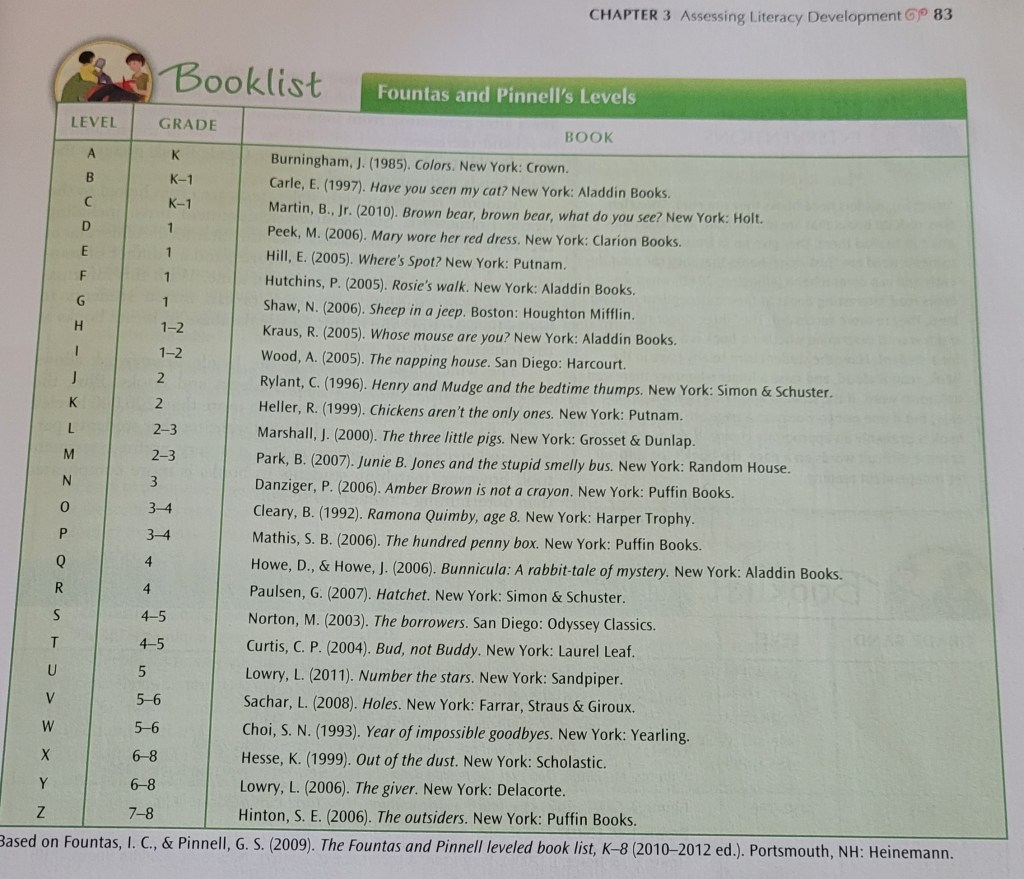
- System developed by Fountas and Pinnell: text gradient or classification system that arranges books along a 26-level continuum from easiest to hardest. The system is based on variables that influence reading difficulty such as:
- Genre and the format of the book
- Organization and use of text structure
- Familiarity and interest level of the content
- Complexity of ideas and themes
- Language and literary features
- Sentence length and complexity
- Sophistication of the vocabulary
- Word length and ease of decoding
- Relationship of illustrations to the text
- Length of the books, its layout, and other print features
- Another strategy for categorizing books for different levels of readers is the Lexile Framework developed by MetaMetrics.
- This strategy differs because it is used to measure both students’ reading levels and the difficulty of books.
- Word familiarity and sentence complexity are used to determine the difficulty level
- Lexile scores range from 100 to 1300 and represent Kindergarten through 12th Grade
- The numerical scores are organized into grade level bands that coordinate with Common Core Standards.
- Students results on standardized tests are often linked to the Lexile Framework.
- Many State standardized reading tests will show results based upon a lexile score number.
- This makes it much easier for teachers and parents to find books that are at an appropriate reading level for the student.
- The amount of books in the lexile system is staggering, but it is not only a student’s lexile score on tests that determines what level book they can read.
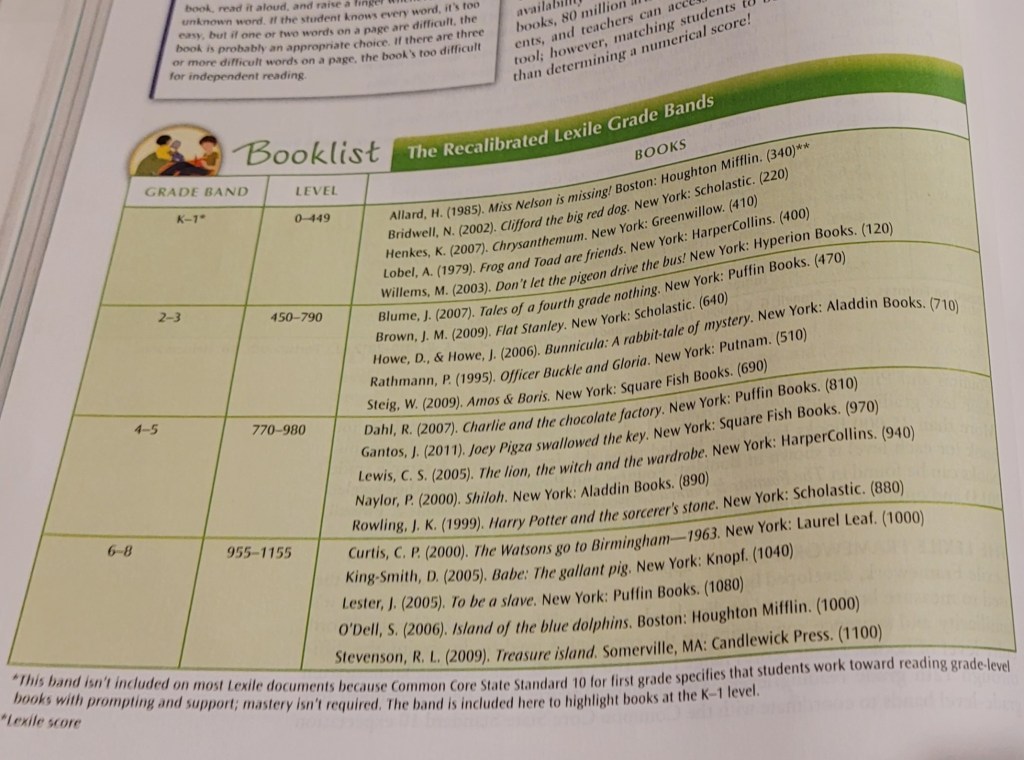
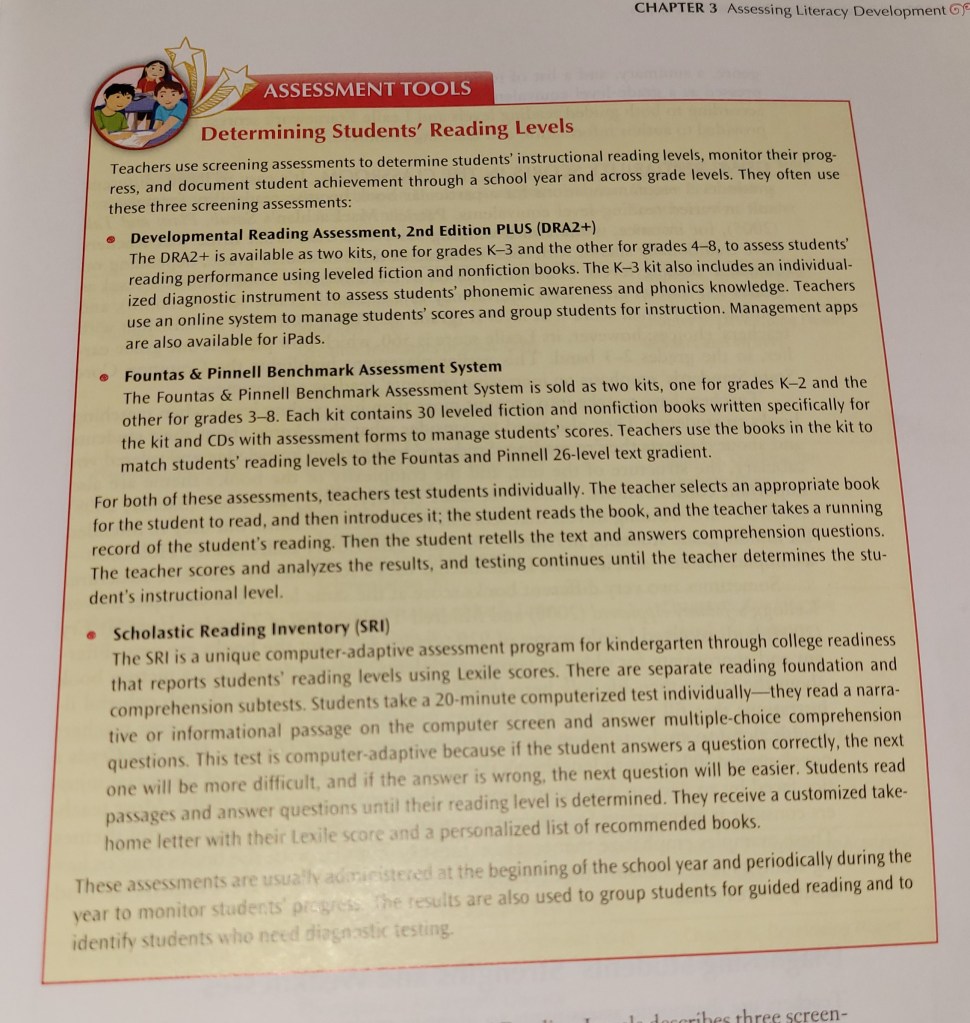
Tompkins, 2017, pg. 84
- Using Readability Scores in the Classroom
- It’s become quite simple to find books that are at specified grade levels because of readability formulas.
- It can become a bit more complicated however when a teacher is comparing readability levels and lexile scores as they do not always line up neatly. Sometimes books will be at one grade in readability, and a grade or two lower in lexile.
- This is because lexile scores more greatly reflect the heightened expectations for college preparedness. Lexiles focus more on challenging students to keep going.
- When teachers are choosing books to introduce to their students, they have to take more into account than just the reading levels of their students. They also must take into consideration the background knowledge that the students already have, the vocabulary that will be used in the books, the structure of the book, and the complexity of the themes that the teacher will be trying to have the students focus on.
- Teachers must be familiar with the books that they are having their students read to ensure that they are appropriate. They cannot rely on the level systems alone!
- Diagnosing Student’s Strengths and Weaknesses
- Educators use diagnostic assessments to determine their student’s ability in
- Phonemic awareness
- Phonics
- Fluency
- Vocabulary
- Comprehension
- Educators use diagnostic assessments to determine their student’s ability in
Here are some examples of Diagnostic Assessments..
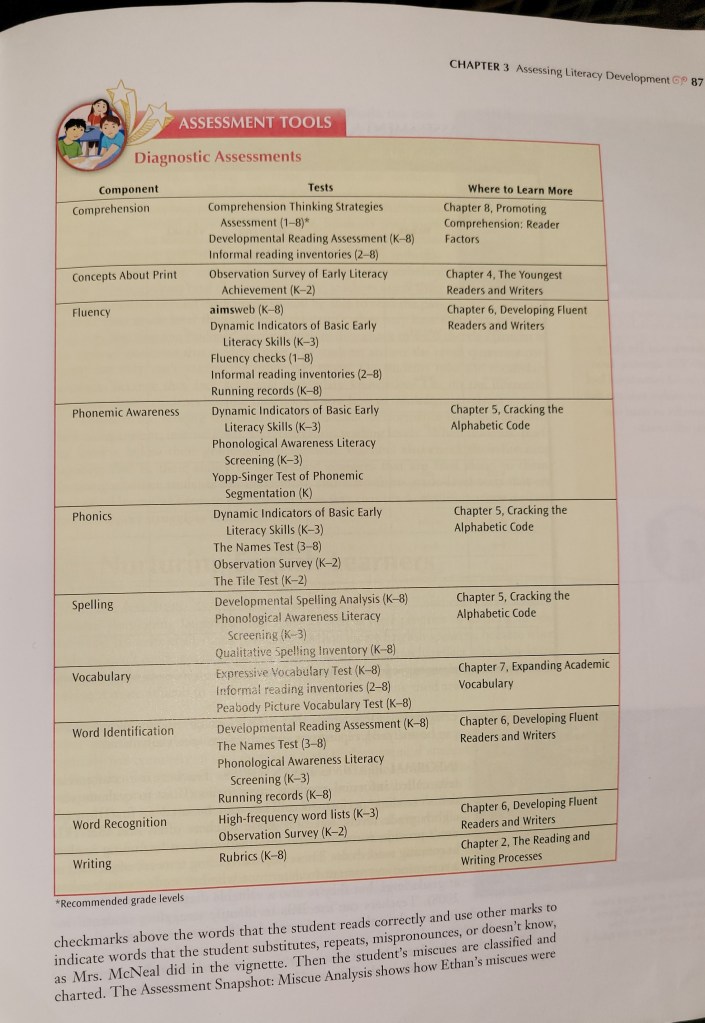
(Tompkins, 2017 pg. 87)
- Running Records: authentic assessment tools because students show they are able to read a text while a teacher evaluates them in real time.
- These running records give teachers a chance to assess students’ word identification skills and reading fluency.
- The Running Record typically will have a portion of a text written out on it word for word. As the student reads, each correct word will get a check mark above it. Any errors will be noted.
- The students mistakes will then be recorded and evaluated using a Miscue Analysis.
- Only words that students mispronounce, or substitute can be analyzed. Repetitions or omissions are not calculated here.
- Informal Reading Inventories: Commercial tests. Used to evaluate students’ reading performance. Can be used for first grade through eighth grade.
- These tests are often used for screening to ensure that students are capable of reading at grade level. But they can also be used to identify struggling students’ instructional needs in areas like word identification, oral fluency, and comprehension.
- Typically these types of tests will consist of 2 parts: graded word lists and passages ranging from 1st to 8th grade levels.
- The word lists contain about 10 to 20 words for each level, and students will read them until the words become too difficult.
- When they become too difficult this is an indication of what the cut-off is for an appropriate level for students to begin reading the passages.
- Teachers will analyze the words that the students read incorrectly to look for error patterns (Tompkins, 2017).
- For the passage portion, students will read passages either orally or to themselves, and then answer a few comprehension questions about what they read.
- When students read the passages orally, teachers are able to analyze their fluency. If a student cannot read the passage for their grade level they may be dealing with some fluency problem.
- Teachers will also look at the student’s comprehension and try to determine if there are any patterns to comprehension questions that were missed.
- Teachers use scoring sheets to record and evaluate all this data.
- If a student’s reading level is below grade level, a teacher will then attempt to test the student for their listening capacity; or their ability to understand the text if it is read to them.
- This is a crucial part of the puzzle in determining what kinds of differentiation must be used for students to succeed in the classroom.
- Nurturing English Learners
- Assessing ELLs reading levels and comprehension levels can be a lot trickier than normal. Since they are not fluent in English, the scores do not accurately reflect what they know.
- Oral Language Assessment: Students who speak a language other than English at home may be assessed by their teacher to check their English Language Proficiency.
- If students are not proficient in English they help them to get into programs to support their language learning and monitor their progress towards proficiency with English.
- Most commonly used assessments are: Language Assessment Scales and the IDEA Language Proficiency Test
- Both tests assess K-12 students on oral, written, and visual language proficiency in English
- An authentic assessment tool that many teachers use is the SOLOM or the Student Oral Language Observation Matrix. This is a preferred assessment in that it is not a test, but rather it is a rating scale that teachers can use to rate how ELLs are doing with their command of English.
- The SOLOM addresses five components of oral language
- Listening
- Fluency
- Vocabulary
- Pronunciation
- Grammar (Tompkins, 2017)
- Each component has a 5-point scale and the maximum score on the matrix is 25. A score of 20 or higher indicates that a student is fluent in English.
- The SOLOM addresses five components of oral language
- Reading Assessment: ELLs often struggle because they are trying to learn to speak English while also learning to read.
- They learn to read the same way that native English speakers do, but they face additional challenges because their knowledge of how English works is limited.
- They also are challenged because their background knowledge is different.
- Teachers typically will use the same assessment for ELLs as native English speakers for determining reading levels
- Because ELLs are often lacking background knowledge it is crucial that teachers understand what background knowledge the ELL already has.
- One of the best ways to do this is by using KWL charts. This chart helps them to find out what the student already knows about a topic, and gives the teacher a valuable opportunity to build background knowledge and vocabulary that may be necessary during the reading.
- Teachers can also use formative assessments like conferences with the student at their desks to see how they are doing with their reading. What do they do when they come across a word they don’t know? What reading strategies are they using?
- Writing Assessment: ELLs writing develops as their oral language skills grow and they become more fluent readers and speakers.
- For beginning writers, fluency is the first and main priority.
- They will start by writing sentences that group familiar words together. Then they will keep following the scaffolding that the teacher sets up for them.
- Until they become fluent, ELLs will at times repeat themselves in their writing as a way to fill in the gaps. As they become more fluent they will be able to structure their writing more strongly.
- Teacher’s assessments of ELs Writing should include
- Monitoring students’ ability to write quickly, easily, and comfortably
- Assessing students’ ability to apply writing genres, develop their own topics, organize the presentation of ideas, and use sophisticated vocabulary and a variety of sentence structures.
- Checking that students control Standard English grammar and usage, spell most word correctly, and use capitalization and punctuation properly (Tompkins, 2017)
- Rubrics and revising groups can be very helpful to ELLs as it gives them more concrete information about what is expected on a writing assignment. It also gives them an opportunity to learn more about how others express voice in English writing by allowing them to see what more fluent writers do when writing.
- Alternative Assessments: Because ELLs are facing a lot of difficulties when learning to read and write in English, it is important to vary your strategies for assessment and instruction.
- While teachers can use the same assessments that they use for native English speakers, it can be helpful to use more authentic assessments to truly understand where an ELL is at with their learning and fluency.
- High Stakes Testing
- Annually done in the United States with a goal of improving the quality of reading instruction for the nation.
- Tests are designed to objectively measure student’s knowledge according to grade-level standards.
- These tests began because of fear that we were losing our educational superiority over other nations.
- The NCLB Act reinforced the push on standardized testing.
- High stakes testing is not the same as classroom assessment. These test scores typically provide very little information for making the day-to-day instructional decisions.
- Despite this, states, schools, administrators, and teachers are held accountable for the results of these tests.
- The scores impact things like school placement and high school graduation.
- They also influence administrator’s evaluations of teacher’s effectiveness and even their salaries in some states.
- Standardized tests are comprehensive
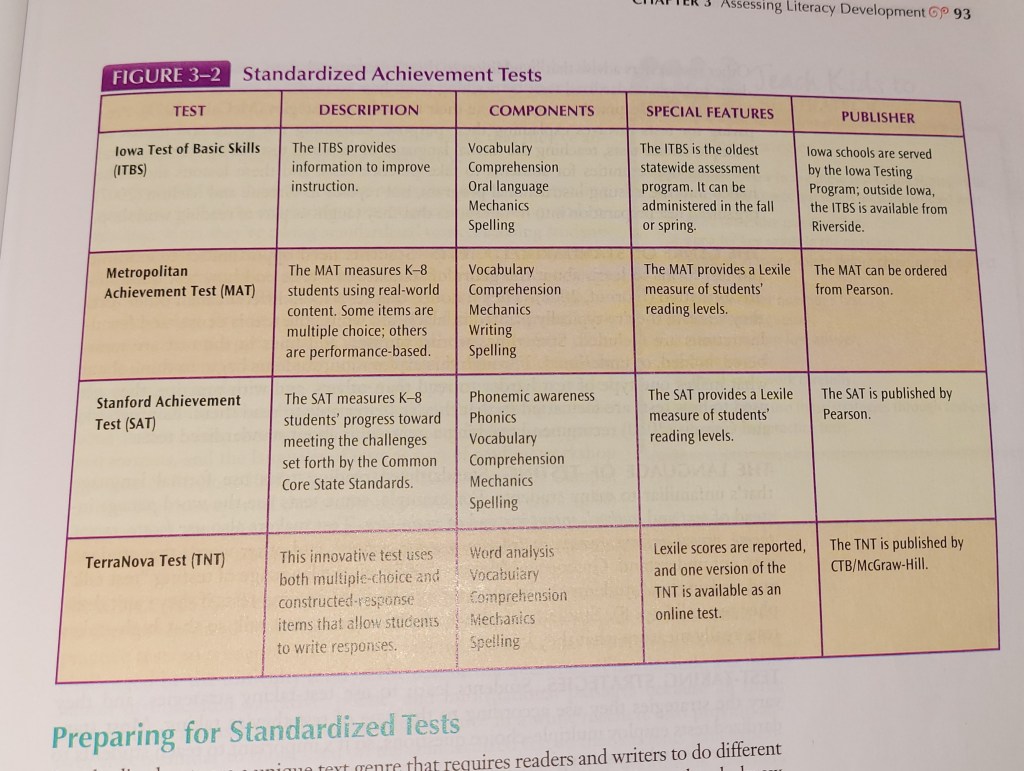
- Problems with Standardized Tests: Students feel pressure of these tests and research has confirmed that students do not try harder because of these tests.
- Struggling students may even get discouraged or feel defeated and over time this test pressure can harm their motivation.
- Teachers also complain that they feel pressured to improve test scores above all else.
- Overemphasizing the test can cause unbalanced instructional practices.
- Preparing for Standardized Tests:
- Standardized tests have text that is unusual compared to the texts that students are used to reading. Teachers cannot assume that students already know how to take reading tests.
- It is essential that teacher prepare students for these while still maintaining a balanced approach to instruction.
- Five ways to help prepare students without sacrificing the instructional program include:
- Checking that the instructional program aligns with the state standards, and make any needed adjustments to ensure that what is being taught matches the concepts that the test addresses
- Set goals with students and use informal assessments to regularly monitor student progress
- Actively engage students in authentic literacy activities so that they become capable reader and writers
- Explain the purpose of standardized tests and how the results will be used in a way that will not make the student more anxious.
- Stick with a balanced approach that combines explicit instruction and authentic application.
- Another recommended strategy is teaching students test taking strategies. This can be taught in minilessons to help cut down on the interference on instructional minutes.
- It is important to remember that standardized tests have reading that differs from most of the reading that students deal with throughout the year. It is helpful to teach them the type of genre to expect when working through these types of tests.
- Test Taking Strategies:
- Read the entire question first
- Look for key words in the question
- Read all answer choices before choosing the correct answer
- Answer easier questions first, then go back to the more difficult ones
- Make smart, educated guesses
- Stick with your first answer
- Pace yourself
- Check your work carefully
- Nurturing English Learners
- Standardized tests are believed to not be an accurate representation of ELLs performance.
- ELs may be more stressed than the average test taker because they are unfamiliar with the concept of Standardized Tests.
- The academic language used in the questions can sometimes be difficult for ELLs to understand.
- Cultural differences can also affect the amount of background knowledge that a student has to base answers on (Tompkins, 2017)
- Researchers suggest that the best way to assess students who are ELLs is to provide accommodations to these students.
- Until research provides an answer to the best option, it is best for teachers to use multiple methods to support ELLs when standardized testing is going to be happening soon
- Standardized tests are believed to not be an accurate representation of ELLs performance.
- Politics of High Stakes Testing: this is a highly charged issue. Does this type of testing actually give us an accurate representation of our students learning? Is it fair to hold these test scores over the teachers and administrations heads? Many researchers argue that at this point, one type of assessment is simply not enough to give us accurate information about student performance.
- Portfolio Assessment:
- Students collect their work in portfolios and use these to evaluate their progress and show case their best work.
- These portfolios show the students’ literacy growth over a period of time.
- Students will choose the work that they decide to put into these portfolios, giving them an incentive to do better, more quality work.
- Portfolios help students, teachers, and parents to see patterns and growth in their students’ learning.
- Some other benefits are:
- Feeling ownership of their work
- Becoming more responsible about their work
- Help students to set goals and get them motivated to work toward accomplishing these goals.
- Helps students to make connections between learning and assessing work (Tompkins, 2017).
- Teachers use portfolios in parent teacher conferences and to supplement the information provided on report cards.
- Collection methods can vary slightly: some school may use a large folder for each student, others may use a box. Portfolios should be kept in a place in the classroom where they are easily accessible to students so they can easily review their work and add new pieces to them.
- Teachers will suggest the types of work to put into the portfolios, and students will choose what goes into it based on those criteria.
- Not only can the portfolios include pieces of writing, but you can also include recordings of oral presentations or readings, artwork, photographs.
- It is important to remember the distinction between teacher work folders and portfolios. Portfolios are much more centered on the student, whereas teacher work folders are more specifically aimed towards grading.
- Portfolios are a great tool for helping students get involved in the assessment and goal setting process.
- By putting items into their portfolios, students get to learn to reflect on and assess their own reading and writing, and their development as readers and writers.
- At the end of the school year, it is also a great idea to allow students to share their portfolios to celebrate students’ accomplishments.
- During this time, they can invite family members, business people. School administrators, local politicians, college students, classmates, and community members where students can share the work that they put into their portfolios.
Source:
Tompkins, G. E. (2017). Literacy for the 21st Century: A balanced approach. Pearson.
Formative Assessment (Strategic Assessment System, Part 1) Video
Assessment is an interesting thing. Not only do students get assessed formally things like standardized tests, but they also are assessed throughout the school day, dozens of times, and a lot of this never is even added to a grade book of any kind. As educators it is important that we can ask the right kinds of questions to assess how our students are learning the material in the classroom. We also want to teach our students how to be capable of self-assessment.
Formative assessments, or those that are not formal, are great for helping teachers to understand where each of their students are at with the learning material. They are also a wonderful tool in helping teachers to adjust and refine their teaching practices. If the students are not catching on to a specific piece of material, a teacher may need to adjust to make that material more relatable to the students.
- Formative assessment is “a deliberate process used by teachers and students during instruction to provide specific, actionable, and immediate feedback” (Wisconsin Department of Public Instruction, 2016).
- Formative practices “promote ongoing reflection and are used to quickly adjust teaching and learning” (Wisconsin Department of Public Instruction, 2016).
It is important to remember that formative assessment can actually have huge benefits for students. Formative assessments are one of the only kind of assessments that allow you to transform the way you teach to improve student learning. For formative assessment to be effective, teachers must ensure that students understand the learning goals. If students don’t know what the goals are, it is quite hard for them to make self-assessments about their own progress. This assessment process has multiple steps.
- Teachers need to gain a deep understanding of the learning goals (this step is often overlooked!)
- Envision proficiency in each standard
- Designed by teacher for use with their own instruction
- Use information gathered from formative assessment to adjust instruction
Source:
Wisconsin Department of Public Instruction. (2016). Formative Assessment (Strategic Assessment System, Part 1). YouTube. Retrieved October 10, 2022, from https://youtu.be/h8O0hQ32IIQ.
Summative Assessment (Strategic Assessment System, Part 3) Video
The purpose of summative assessment is to evaluate learning through snapshots of student performance at the end of a specified time. This can be accomplished through standardized tests as well. Summative assessments try to answer the questions; did all our students learn the material? Are all our students meeting the standards? Are we successful with all our students?
Before a summative assessment can take place, a student will have had the opportunity to learn the material, have conferences with their teacher about their progress towards the learning goals. They will have been given many different iterations of written feedback to help them to understand whether they are on target or not. In other words, there were interim assignments and formative assessments already used to ensure that the student was on the right track.
Summative assessments do not have to be tests! They can be portfolios, essays, presentations, or other projects that are a culmination of the skills that the student has learned throughout the unit. Summative assessments provide evidence of a student’s understanding of a concept or series of concepts. Summative assessments can also be used to keep the public informed about school performance.
Summative assessments are great for comparing students to other members of the class, the district, the state, or even the nation. They help us to know where our instruction is, versus the rest of the United States: this helps us know if we are reaching all students equally.
Source:
Wisconsin Department of Public Instruction. (2016). Summative Assessment (Strategic Assessment System, Part 3). YouTube. Retrieved October 09, 2022, from https://www.youtube.com/watch?v=ySYFrQDRZHQ&ab_channel=WisconsinDPI-ResourcesfortheField
Running Record Analysis (Video)
Running Records are beneficial to teachers for a variety of reasons. To start with, they show which strategies students are using when reading. They are also a great indicator of whether students are understanding what is being taught. Running records allow us to plan for further instruction by knowing what our students are doing well with and what they are struggling with. Results from the running records can give the teacher valuable information about what literacy topic needs improvement. It could be fluency, word choice, vocabulary, or word study.
When working through a running record it is important to make sure that the student is fluent in 90-95% of the text. This is the perfect level of understanding for this kind of text, not too hard, not too simple.
During the running record, a teacher will mark what words the student got correct in a short selection and the words they got wrong. When they mispronounce or misidentify a word, a teacher will make a notation of it on the running record, so we know that it was a word the child was struggling with. If students get stuck on certain words in the passage, we can give them time to try to figure them out, and if they cannot figure out what the word is, we can tell them. When we tell them what a word is, we need to mark that on the sheet as well.
When the student finishes the reading, you can then evaluate their skills with meaning, syntax, and visual skills. Sometimes they will have great visual skills at identifying words, but they will have issues with their syntax or meanings. This is ok, but we need to record this so we know where each student is at with these concepts throughout the reading.
Source:
EHE Department of Teaching and Learning. (2014). Running Record Analysis. YouTube. Retrieved October 10, 2022, from https://www.youtube.com/watch?v=m7qhJZzuiLQ&ab_channel=EHEDistanceEducationandLearningDesign.
Classroom Application:
In my future classroom, to be an effective teacher, I will need to use many kinds of assessments to be successful. Formative assessments will happen throughout units and will be used to guide my teachings. Summative assessments will be used at the end of a unit to verify student understanding of concepts, and as evaluation of my teaching.
From the chapter, I got quite excited about running records. These are a fantastic tool to help teachers see in real-time how their students are doing with fluency and comprehension. I think they are great because you can make notes as the student reads and use this information to guide you in your selection of topics for things like minilessons or group work. I also liked that I could use them as a way of assessing how much a child has grown in their fluency over time. Comparing a running record at the beginning of the school year to one halfway through the year or at the end of the year, would be incredibly interesting. It would show us what progress the child was able to make with their reading and how effective I was at teaching them these skills.
I also really loved the idea of student portfolios. Having a way for students to showcase their work from a grading period or school year is awesome! It gives them some confidence in their abilities, and also encourages them to do their best work so it can be included in their portfolio. Allowing them to have a special time to share it with their peers, family members, and others is also a great idea. The items that they put into these portfolios are things that they are incredibly proud of! They need to be able to share them!
 Heather Owen : Reading and Language Arts Methods Notes
Leave a comment