Post 3: Heather Owen, EngEd 270, Chapter 2: The Reading and Writing Process
Vocabulary:
- Shared Reading: When a class or group will read a book together. Someone will read aloud (usually the teacher) while the students follow along in their books.
- Grand Conversation: A student-led whole-class discussion around a specific topic from the reading that they have completed.
- Minilessons: a short meeting with the whole class group or small groups that takes place during a reading workshop
- Reading Logs: Use often in guided reading and home readers. Helps parents and teachers to track the readers that students bring home. Within the logs students write their reactions to what they are reading, predictions about what they think will happen next, or about things that the story reminds them of.
- Learning Logs: Used during thematic units. Students take notes of important information or draw chars and diagrams in learning logs.
- Word Wall: A wall that is used in the classroom for important vocabulary from the readings that the class is completing. The words that are added to the wall can be new or unfamiliar, or just important to the story.
- The Reading Process: a series of stages that a reader goes through to comprehend a text.
- Prereading: The first stage of the writing process. Readers are preparing to read. Teachers can use this stage to build background knowledge for their students and stimulate interest in the concepts of a story. During this stage, readers will
- Activate background knowledge
- Set purposes
- Make Plans for reading
- Background Knowledge: Students have two types of this: general and specific.
- General Knowledge: are things like world knowledge, and information that has been acquired through life experiences and learning
- Specific Knowledge: is literary knowledge, or what students read and comprehend from a text.
- Interactive read-aloud: A method used by teachers to read aloud books that are developmentally appropriate but written above students’ reading levels. Throughout the reading, teachers will engage students in the reading by asking questions, having students make predictions, and make connections.
- Guided Reading: Teachers work with small groups of four or five students who read at the same level. Students do the reading themselves, although the teacher may read aloud to get them started. These lessons typically last about 25-30 mins.
- Partner Reading: Students read or reread a selection with a classmate, an older student, or an aide.
- Independent Reading: Students reading independently, silently, for their own purposes and at their own pace.
- Close Reading: The purposeful rereading of a complex or challenging text to understand big concepts, determine the purpose of a piece, and reflect the meaning of words and sentences. The teacher uses this as an opportunity for scaffolding.
- Story Boards: A way for students to visual represent their reading. Students will used illustrations from books to put together the events in the story, organize the plot, characters, and other elements of the story.
- Word sorts: A type of student activity where students get to practice categorizing words.
- Semantic Feature Analysis: charts that examine relationships between words.
- Readers Theatre: A was for students to present dramatic readings of different stories. The use the text of a story or piece of literature and vocal expression to help the audience to understand the story.
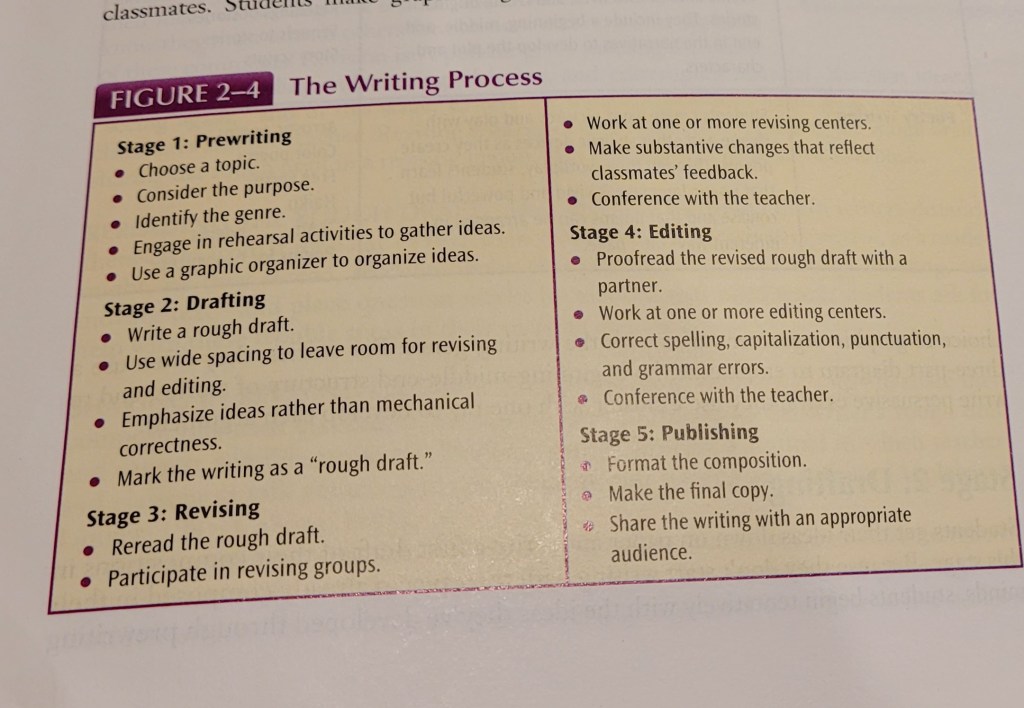
- The Writing Process: A series of five stages that describe what students think about and do as they write.
- Prewriting
- Drafting
- Revising
- Editing
- Publishing
- Revising Groups: Groups where students will present something they’ve written for revision. Group members look at the writer’s rough draft and will suggest possible revisions.
- Proofread: Students do this to locate and mark possible errors in grammar, spelling or other things in their writing.
- Conventions: Spelling, capitalization, punctuation, and grammar.
- Literacy Strategies: deliberate, goal-directed actions. These strategies are linked with motivation
- Literacy Skills: automatic actions that occur without deliberate control or conscious awareness. The goal is effortless and automatic use of these skills.
- Think-Alouds: Teachers demonstrate the thought process of readers and writers as they read and write. The teacher thinks aloud or explains what they are thinking so that students become more aware of how capable readers and writers think.
Source:
Tompkins, G. E. (2017). Literacy for the 21st Century: A balanced approach. Pearson.
Key Concepts
- The Reading Process: Remember that reading is a constructive process of creating meaning that involves the reader, the text being read, and the purpose within social and cultural contexts.
- The goal:Comprehension or understanding the text and being able to use it in a specific way. There are several components to this process including the following:
- Phonemic Awareness and Phonics: How are sounds manipulated into spoken words? How are phonic rules used? Students develop these skills as they read and go through phonemic awareness and phonics instruction in the primary grades.
- Word Identification:Students learn to recognize common or high-frequency words automatically. They use their phonics skills to help them to figure out unfamiliar words.
- Fluency: Students become fluent in reading when they can recognize most words automatically, read quickly, and use expression while reading. Beginning readers spend most of their time trying to decode words, but fluent readers can focus on comprehension.
- Vocabulary:Knowing the meaning of words influences comprehension because it is much more difficult to understand what you are reading when the words being read don’t make sense.
- Comprehension:To create meaning, students will predict, connect, monitor, repair, and use other strategies while reading. They will also use background information, knowledge of genres and literary devices (Tompkins, 2017)
- The Reading Process is organized into five stages as well….
- Stage One: Prereading
- Stage Two: Reading
- Stage Three: Responding
- Stage Four: Exploring
- Stage Five: Applying
- Stage One: Prereading: Occurs as readers prepare to read. This process involves activation of background knowledge. This includes both general, world knowledge and specific knowledge.
- To trigger the activation of this knowledge, students think about the title of a book or piece of reading, examine the book cover and illustrations, and read the first paragraph.
- If students lack background knowledge teachers fill it in by building that knowledge base.
- It is not enough to just build a students’ knowledge about the topic they are reading, they must also gain literary knowledge! It is essential to their success!
- Prereading also involved the process of setting purposes. This is important because the purpose guides the students’ reading. As students become better readers, they also become more effective at choosing books and setting their own purposes (Tompkins, 2017).
- Planning for reading is also involved in the prereading phase.
- This can look like students making predictions about the characters and the events that will take place in the story.
- These predictions can be shared out loud or they can be written in reading logs.
- For nonfiction books the prereading phase is a little different. Students might look at the pictures of a nonfiction book, or at the section headings. They could also look at the table of contents or index to find what sorts of topics the book will cover.
- To help with planning, teachers will use anticipation guides and prereading plans
- This can look like students making predictions about the characters and the events that will take place in the story.
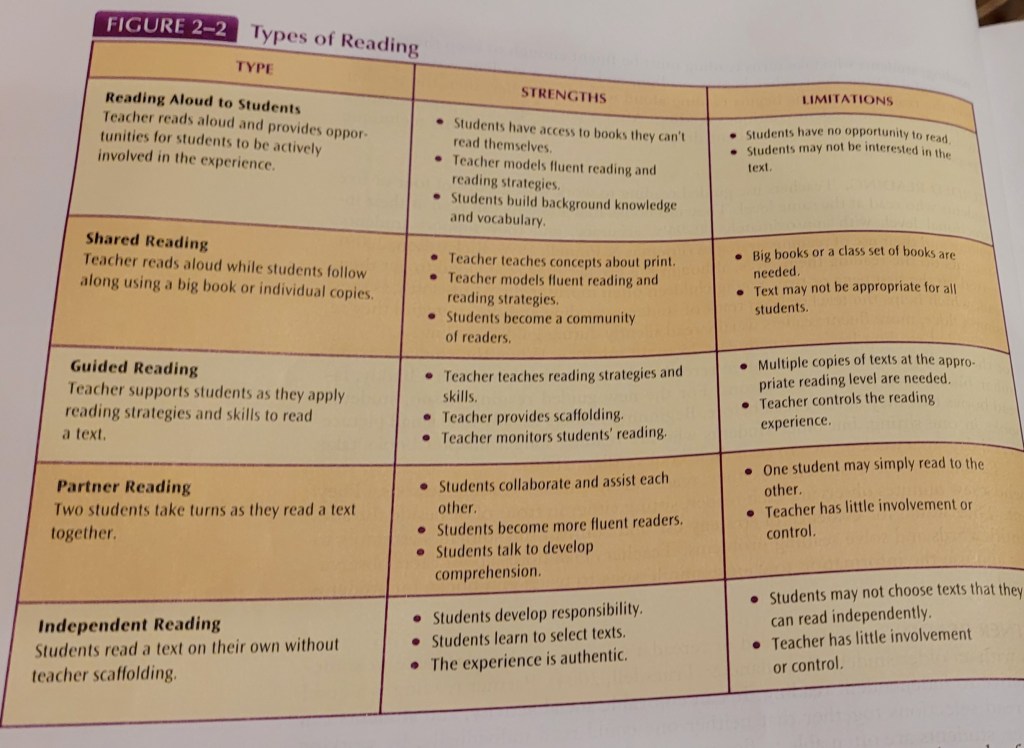
- Stage Two: Reading: This is the actual process of reading a book or other text. In the classroom there are five types of reading
- Reading Aloud to Students: in this process teachers will choose books that are developmentally appropriate but written above students’ reading levels.
- Throughout the read aloud, teachers will engage students in the story rather than having them wait to the end to discuss topics covered or talk about new concepts they hear about in the text.
- As teachers read aloud they model what good readers do and how good readers use reading strategies. This also gives them an opportunity to model how to think aloud
- Read aloud has many benefits such as introducing vocabulary, modeling comprehension strategies, and increasing students’ motivation (Tompkins, 2017).
- Shared Reading: Teachers use shared reading to read books aloud or as a group, that the students would not be able to read on their own.
- Throughout the shared reading, teachers model what experienced readers and writers do when reading a challenging text.
- This can be useful in the primary grade levels and with more experienced readers. The key is to ensure that if students are reading aloud they are fluent enough for it to be meaningful.
- One popular version of this is known as “popcorn reading” where the teacher will start off reading aloud, and eventually a student begins reading along with them. The teacher will then drop off the read aloud while the student continues. Eventually another student will join the previous students and this pattern continues.
- Guided Reading: Teachers use guided reading when they work with four or five students who are all at about the same reading level. The teacher will choose a book for the group that they can read about 90-95% fluently.
- Students will do the reading themselves with the teacher guiding them.
- Guided reading usually lasts 25-20 minutes
- This is a valuable time for teachers to observe students reading. Teachers spend a few minutes observing each reader, watching for evidence of strategy use and are there to help confirm student’s attempts at identifying words they may not have seen before.
- Teachers will take notes on these observations and use these notes to select minilesson topics later (Tompkins, 2017).
- Partner Reading: students read or reread a text with a classmate or older student. Partner reading is an excellent alternative to independent reading.
- Often students can read more fluently together than they could have alone
- It is crucial that the teacher instructs the students on the proper way to do partner reading or the stronger reader will dominate the pair and the strategy will prove to be ineffective.
- Independent Reading: This strategy allows students to read to themselves (typically silently), at their own pace, and for their own purpose.
- This is the most authentic type of reading.
- This is the strategy that helps students to develop a love of reading and confidence in their own reading abilities.
- Reading Aloud to Students: in this process teachers will choose books that are developmentally appropriate but written above students’ reading levels.
- The goal:Comprehension or understanding the text and being able to use it in a specific way. There are several components to this process including the following:
(Tompkins, 2017, pg. 44)
- The type of reading that is used will vary based on how the teacher is scaffolding. Each reading type uses a different amount of support with independent reading using the least and reading aloud the most.
- To decide what type of reading to use, teachers must look at the purpose for reading, the students’ reading levels and the number of available copies of the text.
- Stage 3: Responding: Students respond to reading after they have completed a piece and use this to negotiate meaning or purpose to the writing.
- Students make tentative and exploratory comments immediately after finished reading in reading logs or participating in grand conversations or other group discussions.
- Writing in Reading Logs: Reading logs are places that students can collect their thoughts and feelings about something they are reading or just finished reading. As they write about what they’ve read, it helps them to get their thoughts in order. When students use a reading log with a nonfiction book it is generally used for important factual information, charts, or diagrams and is called a learning log.
- Participating in Discussions: In grand conversations students have the opportunity to share their personal feelings and thoughts from a text.
- During these discussions students will try to figure out why authors wrote their stories the way that they did, or they find a way to relate the reading to their own lives and share this with the group.
- If they are reading a chapter book, students will often also use this time to make predictions about what will happen next in the story.
- Grand discussions differ from normal teacher-led discussions in that the students lead this discussion rather than the teacher. The teacher monitors the discussion and helps guide the student if needed.
- These types of discussions can be done with the entire class, or in small groups. Both options have positive and negatives, including the amount of opinions that will or will not be shared.
- Stage 4: Exploring: This stage is much more teacher directed than the others and very well reflects the teacher-centered theory.
- Rereading the Selection: Students will reread the text and think about what they’ve read. Each time they reread a text they deepen their understanding of it and notice more things about the text than they may have the first time around.
- Close Reading: This is the purposeful rereading of a complex or challenging text to help the readers to understand the big ideas, concepts, vocabulary, and other more complex ideas.
- The teacher typically will scaffold students during this by asking questions about:
- The author’s purpose in the text, ideas, structural elements, word choice, sentence structure, and viewpoints.
- Teachers will choose texts that are at or close to the reading level of the students, but will also ensure it is still challenging enough to warrant rereading for students to practice their literacy strategies.
- This is also a great time to teach students about the concept of annotating or making notes about texts that the students are reading that look at vocabulary, or big concepts.
- The teacher typically will scaffold students during this by asking questions about:
- Examining the Writer’s Craft: Teacher’s plan a variety of activities for students to look at genre, text structures, and literary devices that authors use.
- Students may use story boards made of illustrations from books or ones they have drawn themselves to visually demonstrate a story.
- Students may also write their own short books about the book that they’ve read to get the student to try to think more about the characters and what they are going through in the story.
- During this time the teacher will also tell the students about other works by this author, and sometimes the class will look at multiple books by the same author.
- Students learn about several elements with this strategy including but not limited to:
- Onomatopoeia
- Similes
- Metaphors
- Other forms of figurative language (Tompkins, 2017)
- Focusing on Words and Sentences: Throughout reading different texts, students and teachers add important vocabulary words to a word wall in the classroom. Students will refer back to this wall when they write, do word sort activities, or complete semantic feature analysis charts to look at the relationships between words.
- This is also a helpful strategy in that students also get to focus on important sentences such as those that are using figurative language or other literary devices.
- Teaching MiniLessons: Teachers will give minilessons on various strategies, skills, concepts, and procedures that they see the students need a little bit of practice or focus with.
- They will introduce the topic and then try to use an example from something the class has read together to help make the idea more clear.
- Stage 5: Applying: During this final stage readers extend their comprehension, reflect on their understanding of topics, and find the value of the reading experience.
- Students will often create projects during this stage that could include things like slide shows, posters, readers theater performances, or essays.
- The Writing Process: A series of five stages that describe what students think about and do as they write. Remember that even though there are stages, not all writing processes are in this neat, tidy order.
- Stage One: Prewriting:This is the stage when students get ready to write. Writers begin with brainstorming, thinking, and talking through their ideas to see what direction they want to take their writing.
- While this stage often goes forgotten, it is of crucial importance to the writing process and is key to its success.
- Choosing a topic is also a part of the prewriting phase. These topics should be things that the students are interested in to help promote excitement. Teachers will dictate topics at times, and this is perfectly fine, but try to keep in mind that a broad topic is much less limiting.
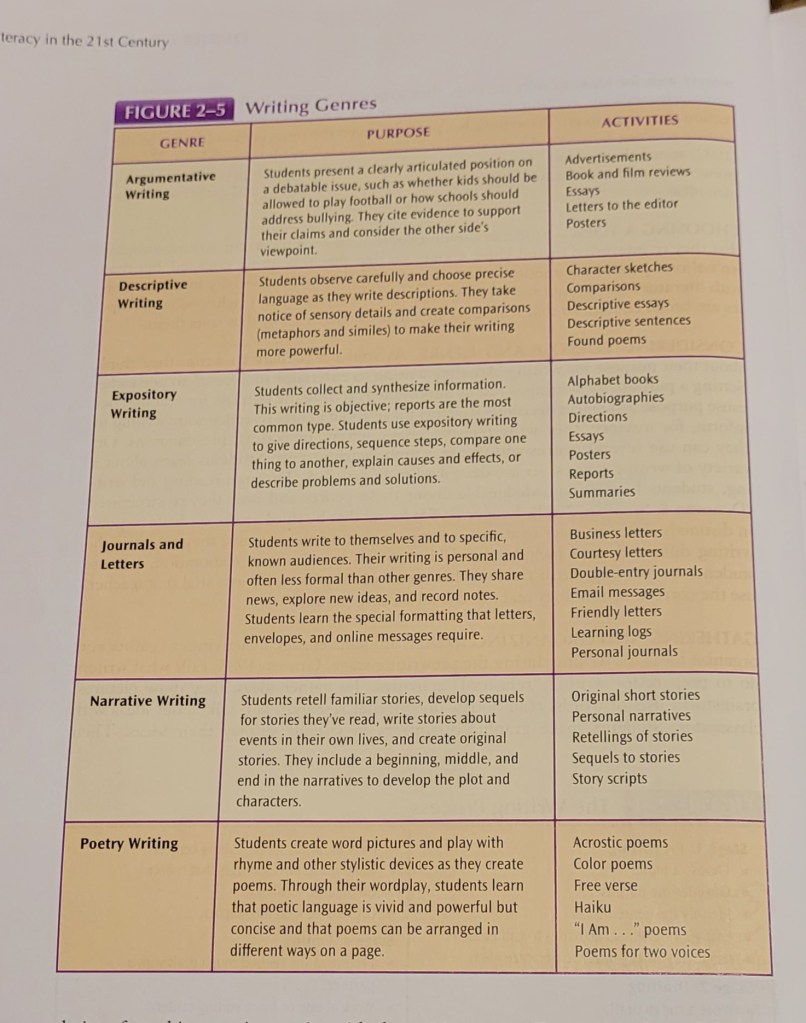
- Students also consider the purpose and genre of what they are going to write.
- Gathering and Organizing ideas is another key aspect of prewriting. Students can draw pictures, charts, or maps to help sort through their thought process (Tompkins, 2017).
- Stage One: Prewriting:This is the stage when students get ready to write. Writers begin with brainstorming, thinking, and talking through their ideas to see what direction they want to take their writing.
(Tompkins, 2017, pg. 49)
(Tompkins, 2017, pg. 50)
- Stage Two: Drafting: This is the stage where students write their first draft of something.
- In this stage it is helpful to have students write their drafts skipping every other line on the paper so they have room for revisions later on. Students should also only write on one side of the paper, that way it can be cut up or changed as needed during revision.
- Students clearly label their rough drafts so that it is clear what the purpose of the work is. There is not a focus on mechanics at this point, it is a exercise on planning and content.
- Computers can be used for rough drafts and can make the final editing process much quicker and neater.
- Stage 3: Revising: During this part of the process students take the time to make changes and adjustments to their rough drafts.
- A lot of students may forget this phase, believing that they are done with the writing task after their draft is complete.
- Revision consists of three activities: rereading the rough draft, sharing this draft in a revision group, and revising it based on the feedback from the previous two activities.
- When rereading the rough draft students should first try to distance themselves from the piece they have written for a while. This will help them to process through the information they’ve written and give them a fresh perspective when they come back to it.
- As the student rereads, they can make changes, edits, adjustments, or rearrange the entire structure of the piece.
- If there are portions that the student is struggling with, they can ask for help in the next activity.
- Sharing in Revision Groups: This is when students get to share their reread drafts with their peers. Group members will look at the rough drafts of their peers and offer suggestions on possible adjustments.
- Students can ask specifically for help with certain sections of their rough drafts
- Typically, revision groups will consist of 4 or 5 people. These can be people who just finished their rereading phase around the same time, or they can be assigned groups by the teacher.
- Making Revisions: Students make four types of revisions. Additions, substitutions, deletions, and moves. They can add words, substitute words or entire sentences, or change the structure of the piece altogether.
- Students will use a colored pen to make these changes on their rough draft so they are easily able to see them.
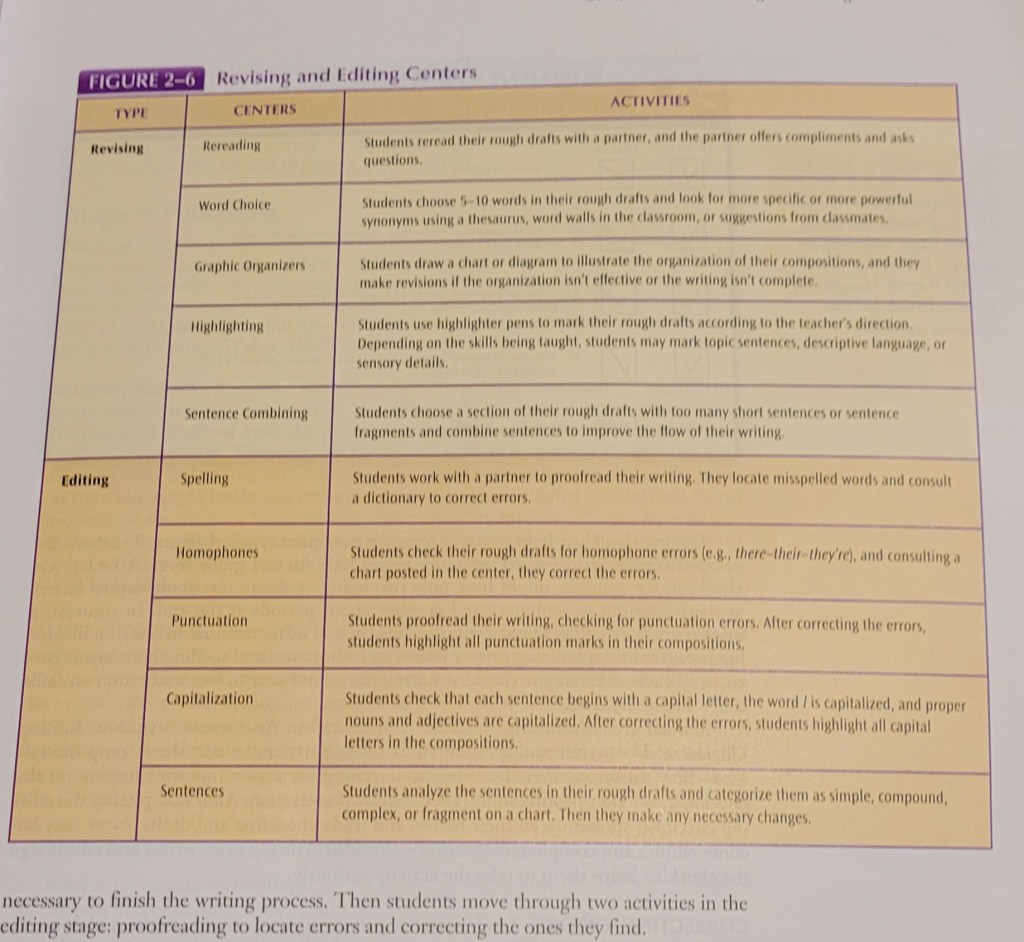
- Revising Centers: These are much more structured ways to help teach students about different aspects of the revision process.
(Tompkins, 2017, pg. 53)
- Proofreading: Students proofread to identify possible errors. It is a very different kind of reading where they must slow down to identify errors. This can be tricky for many students as we train our minds to work towards comprehension rather than noticing errors.
- For this to be successful, teachers must show students how to proofread well and with purpose.
- Students can benefit from editing checklists when first learning to edit. Teachers can edit this checklist throughout the year to bring focus to different tasks that the students have recently learned.
- Stage 5: Publishing: At this stage students will write their final copy of their piece and share it orally with an audience.
- When students get the opportunity to share their writing with peers, parents, or the community- they begin to think of themselves as authors! This helps to motivate them to write more and improve the quality of their writing.
- Making books is a popular way for students to publish their completed works. They can be made by folding paper in halves or quarters, or by stapling sheets together. Students then get to plan the cover and fill the pages of their book.
- One of the best ways to have student’s share their writing is to introduce an author’s chair in the classroom and allow them to read to read their writing aloud to the class.
- Afterward, students can ask the writer questions about their story, offer compliments, and celebrate the completion of the piece.
- Some other ways that student’s can share their writing:
- Read it to parents and siblings
- Share it at a back-to-school event
- Place it in the class or the school library
- Read it to students in other classes
- Display it as a mobile or on a poster
- Contribute it to a class anthology
- Post it on the class website, Seesaw, or wiki page
- Submit it to the school’s newspaper
- Display it at a school or community event
- The best literary magazines for students are Stone Soup and Skipping Stones
- Other options for publishing online or in print include:
- Amazing Kids’ Magazine
- Cyberkids
- KIdsWWwrite
- Poetry Zone
- Stories From the Web (Tompkins, 2017)
- Nurturing English Learners: Writing is a daunting task when you are still learning to speak English. To write well students must know English vocabulary, English sentence structure, and how to spell to help to communicate things in writing.
- ELs can become great writers, so long as their teachers maintain high expectations for them, teach them the ways to write, and ensure they are involved in daily writing activities.
- Topics: sometimes it can be hard for ELs to come up with their own writing topics at first. Teachers can suggest content related topics or show the student a book that is written about a similar topic to help clarify the idea. This will give ELs more practice with the literary terminology that you may use to explain a topic.
- Talk: Students must be able to talk before they are able to write. Conversation is a huge piece of this because they learn about different ways of forming sentences, or new words for their personal word banks, that they can use in speaking and in writing.
- ELs also benefit from the word wall in the classroom because this allows them another visual representation of words.
- Models: ELs will often use pattern books as a model for writing. These books help ELs to learn about new sentence structures and other important literary techniques (Tompkins, 2017).
- Focus on Ideas: ELs may have a hard time understanding the concept of learning about concepts before learning mechanics. When writing a rough draft, they may be confused as to why a teacher is more concerned with the ideas in the writing then the spelling and sentence structure. Try to model this concept for students to clarify what the goal is with those first steps of the writing process.
- ELs can become great writers, so long as their teachers maintain high expectations for them, teach them the ways to write, and ensure they are involved in daily writing activities.
- The Writer’s Craft: These are specific techniques that writers use to gain their readers attention or to convey a purpose or meaning in their writing.
- Examples of this would be things like establishing a clear voice, having a certain organizational system to your writing, choosing precise words so as not to confuse readers, and being able to create effective sentences are all examples of the writer’s craft.
- There are seven traits (“The six traits plus one”) for the writer’s craft (Tompkins, 2017).
- Ideas: The message or meaning. Students pick something that is interesting to them and then narrow it down to develop a main idea.
- This trait includes things like choosing a topic, focusing on that topic, identifying the intended genre, and developing the topic.
- Organization: How a piece of writing is set up with a beginning, middle, and end that engages readers.
- This trait includes the following components: crafting the lead concept, structuring the composition, providing transitions between ideas, ending with a satisfying conclusion.
- Organization will mainly take place during the prewriting and editing phases of the writing process.
- Voice: The style that each writer uses in their own written works is called their voice.
- This trait deals with the concepts of choosing personally meaningful topics, writing with knowledge and passion for a topic, and adopting a certain tone.
- Students create voice with their word choice and the was they structure sentences. Tone is also a very important component of voice.
- Word Choice: the more specific and careful the word choice is, the clearer the meaning of the writing can be. Students learn to choose verbs that are exciting and use certain word to create pictures in the minds of the reader (Tompkins, 2017).
- This trait involves learning how to “paint a picture with words”, choose precise words, energize writing using strong verbs, and word play.
- These tend to be focused on during drafting and revision.
- Sentence Fluency: The rhythm or flow of language.
- Achieving a rhythmic flow, constructing effective sentences, varying sentence patterns, and breaking rules of sentences are all parts of this concept.
- Conventions: Spelling, punctuation, and grammar
- This is mainly used in the editing phase of writing.
- These components are included in this trait: spelling words conventionally, paragraphing accurately, punctuating effectively, capitalizing correctly, and using proper grammar and English rules.
- Presentation: Focusing on making the final draft.
- Addition of text features, formatting of the page, using legible handwriting, and using word processing effectively.
- The way that a text is formatted can impact the piece’s ability to convey certain meanings or messages.
- Ideas: The message or meaning. Students pick something that is interesting to them and then narrow it down to develop a main idea.
- As students learn these traits, they learn what a good writer does.
- Teachers can use minilessons to teach these traits in greater detail.
- Reading and Writing Are Reciprocal Processes: they are both constructive processes that convey meaning. Research supports that reading leads to better writing and that writing has the same impact on reading (Tompkins, 2017)
- Both the reading and the writing process have comparable activities at each part.
- Reading and writing involve concurrent, complex transactions between writers as readers and readers as writers.
- Authors may read other authors books for ideas on what they’d like to write about. Thinking of readers as writers can be difficult at times, but it is important to remember that readers must participate in many of the same activities as writers do- such as activating background knowledge, setting purposes, and evaluating. Though there are several others.
- Many classroom activities involve both reading and writing. Making connections between the two is essential to having an effective classroom. Students read and then write about what they’ve read or they write and read what was written.
- Examples include thinks like reading logs or book reports as students must write about what they are reading. The revision process has multiple opportunities to the writer to read their own work or to have peer read it for them to help with the revisions.
- The following guidelines are helpful to ensuring that students develop a deeper understanding of literacy as they read and write.
- Involve students in daily reading and writing experiences in your classroom (Tompkins, 2017)
- Introduce these processes in kindergarten so that the routines can be developed.
- Plan instruction that reflects the developmental stages of both reading and writing.
- Make the reading and writing connection very clear to students
- Emphasize both the process and the products of reading and writing.
- Teach reading and writing through authentic experiences.
- To be successful readers and writers, students must understand the importance behind the relationship that reading and writing share.
- Literacy Strategies: Deliberate, goal directed actions. Skills are different in that they are automatic actions that occur without deliberate use. Strategies are much more complex and require students to think through what they are doing.
- Reading Strategies:
- Decoding: Phonic and Morphemic analysis
- Word-Learning: Analyzing word parts
- Comprehension: predicting, drawing inferences, and visualizing to understand
- Study: Taking notes and questioning to learn information (Tompkins, 2017)
- Reading Strategies:
- Digital Reading Strategies: Digital texts are different than books. They are a unique genre with their own characteristics. These are:
- Nonlinearity: they do not have the same linear form that books do. Readers impose a structure that fits their needs, and adjust as necessary
- Multiple Modalities: Online texts use words, images, and sounds to create meaning rather than just using written word or pictures.
- Intertextuality: There are many related texts about any given topic online. These different texts help to shape and influence each other.
- Interactivity: There are often interactive portions of websites that help to engage the reader including customizable searches, links to other websites, games, and video clips.
- With this, students must learn four new reading strategies that are more specifically aimed at reading online information.
- Navigating: Students need to know how to navigate to locate information
- Coauthoring: Students become coauthors of online texts as they impose an organization on the information that they are reading
- Evaluating: Students need to learn how to evaluate the accuracy, relevance, and the quality of the information that they find online.
- Synthesizing: Students learn to synthesize the information from multiple texts about similar subjects (Tompkins, 2017).
- Writing Strategies are similar to reading strategies in that they are tools to help students through different compositions.
- Some examples of writing strategies include:
- Prewriting: organizing and developing ideas before beginning to write
- Drafting: Narrowing the topic and providing examples to focus on ideas while creating the first draft
- Revising: Detecting problems, elaborating ideas, and combining sentences to communicate effectively
- Editing: Proofreading to identify and correct spelling and mechanical errors
- Publishing: Designing the layout to prepare their final draft to share
- Some examples of writing strategies include:
- To be successful students need to have explicit instruction on the concepts of reading and writing strategies. This is not knowledge that they can learn simply from reading and writing on their own.
- Minilessons are a great way to help teach these strategies to students. During the minilesson teachers provide three types of information about each strategy:
- Declarative Knowledge: what the strategy does
- Procedural Knowledge: how to use the strategy
- Conditional Knowledge: when to apply the strategy.
- During minilessons teachers will demonstrate the thought processes that readers and writers uses by doing think-alouds. During these, teachers will think aloud or explain what they are thinking so that students become more aware of how capable readers and writers think when working (Tompkins, 2017).
Classroom Application:
In my future classroom I think it is going to be very important to ensure that I teach students about the relationship between reading and writing. Until this class and reading this part of the textbook, I wasn’t aware of how mush the two affect one another.
One of the concepts that I really want to use in my future classroom is the “writer’s chair” so that student’s kind of get excited to share their work with their peers. In a few classrooms that I have worked or observed in, I have seen a special reading chair that is used by a student and each week it changes to a different student. But I have never seen the “writer’s chair” idea before. I think it would help certain students who may be a little anxious about sharing their work with a group because it adds an element of fun to the process.
I also really appreciated learning about different resources for sharing or publishing students writing. I am going to be looking into the two children’s literary magazines to see if I can subscribe to them for our school library! There are so many great resources that we can use in our future classrooms to help get children excited to read and write.
Source:
Tompkins, G. E. (2017). Literacy for the 21st Century: A balanced approach. Pearson.
 Heather Owen : Reading and Language Arts Methods Notes
Leave a comment