Post 2: Heather Owen, EngEd 270, Chapter 1 (Part B): Becoming an Effective Literacy Teacher
Vocabulary:
- Common Core State Standards: (CCSS Initiative) defines the knowledge base that all students from grades K-12 should learn at each of the grade levels.
- Phonological Awareness: an individual’s awareness of the structure of sounds as they relate to words.
- Fluency: In reading, the ability to ready with speed, accuracy, and proper expression. Relates to comprehension. When reading aloud, fluent readers read in phrases and add intonation appropriately.
- Writing Process: Students learn to use this process to compost pieces that are narratives, informative texts, arguments, or responses to literature. The writing process is part of the writing strand of Common Core State Standards.
- Narratives: includes any type of writing that relates a series of events and includes both fiction (novels, short stories, poems) and nonfiction (memoirs, biographies, news stories). Both forms tell stories that use imaginative language and express emotion, often through the use of imagery, metaphors, and symbols.
- Scaffolding: breaking up the learning into chunks and providing a tool, or structure, with each chunk. When scaffolding reading, for example, you might preview the text and discuss key vocabulary, or chunk the text and then read and discuss as you go.
- Shared Reading: teachers use this strategy with their students to read big books with young children. Often in this approach the teacher will read aloud and have the students join in with familiar and predictable words or phrases. Can be used across any grade level.
- Language Experience Approach: (LEA) is a whole language approach that promotes reading and writing through the use of personal experiences and oral language. It can be used in tutorial or classroom settings with homogeneous or heterogeneous groups of learners.
- KWL Charts: KWL, an acronym for Know, Want-to-know, and Learned, is an effective way to read with purpose. KWL is easy to apply and can lead to significant improvement in your ability to learn efficiently and to retain what you have learned.
- Choral Reading: reading aloud in unison with a whole class or group of students. Choral reading helps build students’ fluency, self-confidence, and motivation. Because students are reading aloud together, students who may ordinarily feel self-conscious or nervous about reading aloud have built-in support.
- Readers Theatre: students “perform” by reading scripts created from grade-level books or stories. Usually they do so without costumes or props. Reader’s theater is a strategy that combines reading practice and performing. This approach may help get students excited about reading.
- Interactive writing: students and the teacher create a text and write a message. The text is created by the group together, and the teacher assists as students write the text on chart paper. Helps practice reading and writing high-frequency words.
- Minilessons: As a whole-group instructional context, reading minilessons are concise, explicit lessons with a purposeful application in building your students’ independent reading competencies.
- Collaborative Book: A book that students work on in class together. The students may each do a page, but together they form a story made by collaboration.
- Book Talk: a short (30 second – 2 minute) speech designed to encourage someone to read a book, giving an idea of plot, characters, or themes of the book, but, unlike a book report, does not summarize the whole plot or give away the ending or major plot points.
- Basal Readers: Commercially produced reading programs. These programs feature a textbook for reading selections and can include workbooks, supplemental books, or other instructional materials.
- Assessment: Teachers use a variety of informal and formal assessments to assess where their students are preforming. These assessments can be used to help assess whether a student is at grade level or not, or to see if they are understanding the concepts taught in a lesson.
- High-Stakes Tests: standardized testing. Any test used to make important decisions about students, educators, schools, or districts, most commonly for the purpose of accountability
- Running Records: records of students’ oral reading that analyzes their ability to solve reading related problems
- Rubrics: used to assess students’ performances, written pieces, and any projects. Helps to create a clearer picture of the expectations of an assignment.
- Guided Reading: students real leveled books on eReaders or tablets for independent practice. They also can listen to books read aloud on these technological resources.
- Literature Circles: Students gather in small groups to read a story or a book. Teachers will select 5 or 6 books at different levels to meet the needs of the class. Teachers will give a short book talk to introduce the book to the class. Then students choose a book to read and form a group to read and respond to the book. Assignments will occur for the group as they progress through the book.
- Differentiation: Teachers may vary instruction and application activities to meet the needs of their students. They can differentiate things in multiple ways.
- Nurturing English Learners: Students learning English benefit from participating with their mainstream peers in class. It is important the teachers ensure they are developing a classroom community that is accepting of each student’s differences. Teachers also scaffold students’ oral language learning and their literacy development throughout this process.
Source:
Tompkins, G. E. (2017). Literacy for the 21st Century: A balanced approach. Pearson.
Key Concepts
- Principle 5: Effective Teachers Address Standards
- Common Core State Standards (CCSS) Initiative identifies the knowledge that students should learn at each grade level K-12.
- These standards show teachers what should be taught but leave it up to them how to do so.
- 5 Strands to CCSS
- Reading Strand: consists of 3 sections: foundational skills, literature, and informational text. Younger students begin with foundational skills like phonological awareness, word recognition, and fluency. As they understand these foundational skills they can move onto more complex texts.
- Standards in this section are grouped by these topics
- Key Ideas and Details
- Craft and Structure
- Integration of Knowledge and Ideas
- Range of Reading and Level of Text Complexity
- Standards in this section are grouped by these topics
- Writing Strand: students focus on learning the writing process. Respond to literature and work on related research projects.
- Standards in this section are grouped by these topics:
- Text types and Purposes
- Production and Distribution of Writing
- Research to Build and Present Knowledge
- Range of Writing
- Standards in this section are grouped by these topics:
- Speaking and Listening Strand: mastery of oral language skills, discussion skills, and oral presentations.
- Standards in this section are grouped by these topics:
- Comprehension and Collaboration
- Presentation of Knowledge and Ideas
- Standards in this section are grouped by these topics:
- Language Strand: Students apply vocabulary, grammar, and Standard English conventions to increasingly sophisticated oral and written presentations.
- Standards in this section are grouped by these topics:
- Conventions of Standard English
- Knowledge of Language
- Vocabulary Acquisition and Use
- Standards in this section are grouped by these topics:
- Media and Technology Strand: the critical analysis of media and the creation of projects within this realm (Tompkins, 2017).
- Reading Strand: consists of 3 sections: foundational skills, literature, and informational text. Younger students begin with foundational skills like phonological awareness, word recognition, and fluency. As they understand these foundational skills they can move onto more complex texts.
- 5 Strands to CCSS
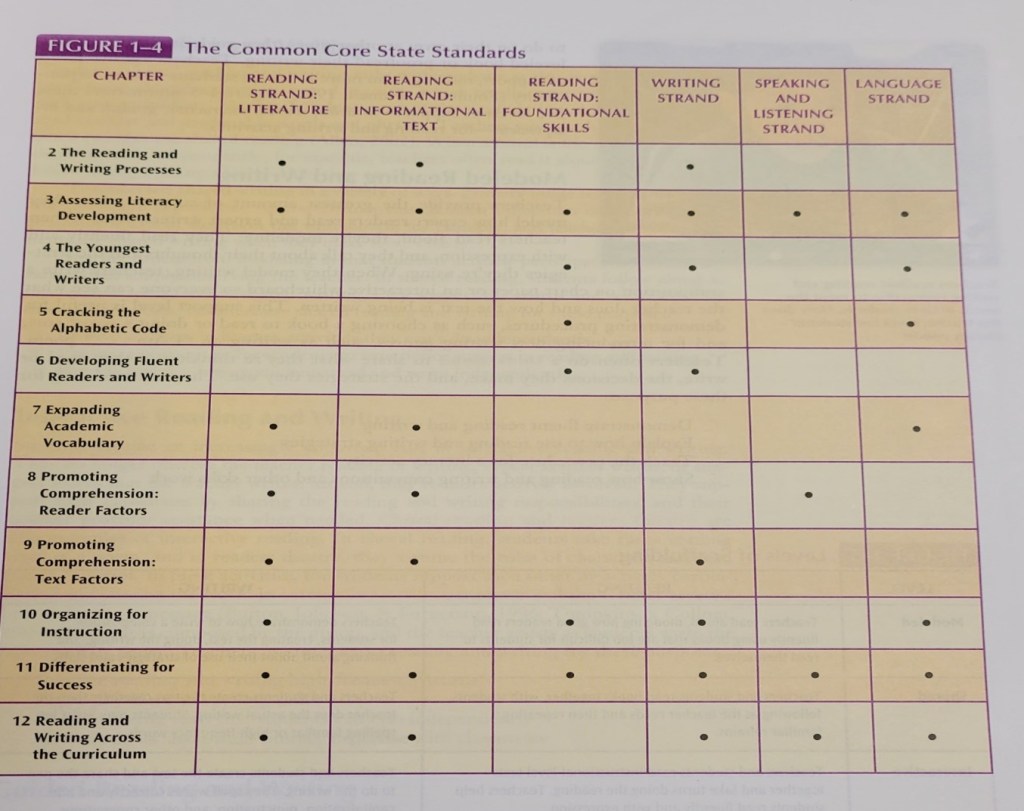
(Tompkins, G. E., 2017, pg. 21)
- Principle 6: Effective Teachers Scaffold Students’ Reading and Writing
- Teachers scaffold students reading and writing by demonstrating, guiding, and teaching. Depending on the students, they vary the amount of support and guidance they need to offer.
- Teachers generally use 5 levels of support
- Modeled
- Purposes: demonstrate fluent reading and writing. Explain the use of different reading and writing strategies. Teach procedures for literacy activities. Show how reading and writing conventions and other related skills work.
- Shared
- Purposes: involve students in literacy activities that they are unable to do alone. Create opportunities for students at all levels to experience success with reading and writing. Provide practice.
- Interactive
- Purposes: Practice high-frequency words. Learn to apply phonics and spelling skills. Read and write thing that students could not do alone. Have students share their literacy expertise with classmates.
- Guided
- Purposes: Support students reading and writing with appropriately leveled materials. Teach skills and strategies for reading a writing. Involve students in collaborative experiences. Teach students to use the writing process (revision and editing).
- Independent
- Purposes: Create practice opportunities.
- Provide authentic literacy experiences
- Develop lifelong readers and writers (Tompkins, 2017)
- Modeled
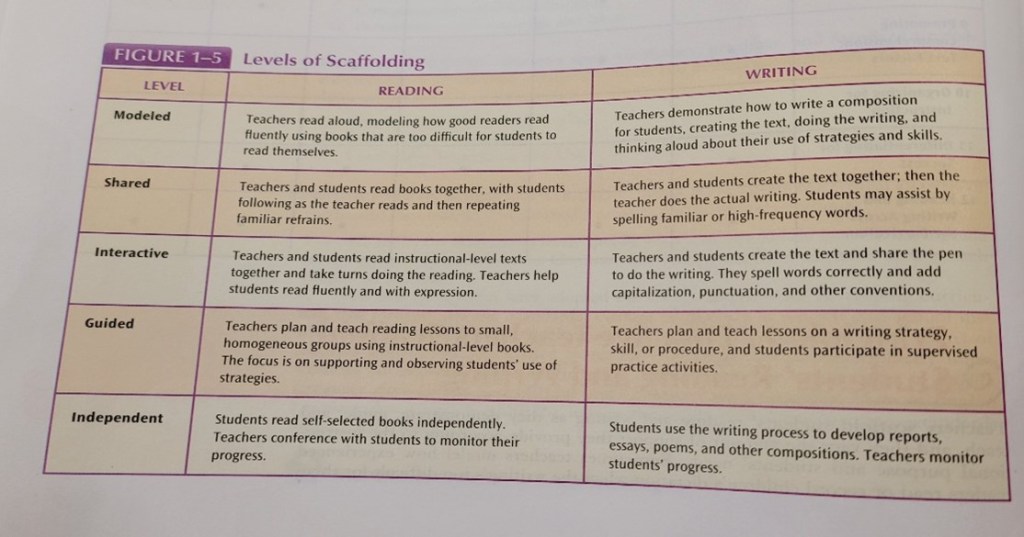
(Tompkins, G. E., 2017, pg. 22)
- Principle 7: Effective Teachers Organize for Instruction
- No program is a one-size fits all concept for teaching literacy. Rather, teachers must use bits and pieces to create a program that works for their students and meets school and state standards.
- Instructional programs should reflect these principles:
- Teachers need to establish a community of learners in their classroom
- Teachers incorporate a balanced approach
- Teachers use scaffolding
- 5 of the most popular programs used by teachers for developing literacy are: guided reading, basal reading programs, literature focus units, literature circles, and reading and writing workshops.
- Guided reading: Teachers can use this to help personalize instruction. They meet with groups of students who are approximately at the same reading level to read a text and comprehend its meaning. Typically used in K-3
- Basal Reading Programs: Commercially produced reading programs that typically are textbook based and offer other instructional materials and workbook. Companies will tout that their product fully encompasses all needs within the classroom, but experienced teachers realize that there is more to it than a program could cover.
- Literature Focus Units: Teachers create literature focus units featuring high-quality picture books of novels that typically are state or district approved and are expected to be read at a particular grade level. Everyone in the class reads and responds to the same book and the teacher guides them through the book.
- Literature Circles: small groups that read a story or book. The teacher pre-selects books that the group can choose from and introduces them with a book talk. Then groups choose a book to read and respond to. The students set the reading schedule and discussions. Helps to develop a sense of student responsibility
- Reading and Writing Workshop: Students select books, read independently, and conference with the teacher about their reading. They also will write and meet with the teacher about what they are writing. These workshops give them time to practice reading and writing skills on a more complex or even adult level (Tompkins, 2017).
- Nurturing English Learners: ELs benefit “from participating in the same instructional programs that mainstream students do, and teachers create classroom learning contexts that respect minority students and meet their needs” ((Tompkins, G. E., 2017, pg. 26)
- Students who are learning English can struggle with reading and writing because they are also learning to speak the language.
- Teachers can better serve these students by scaffolding oral language acquisition and literacy development.
- Explicit Instruction: ELs are more at risk than other students. Teachers present additional instruction on literacy strategies and skills due to this. Extra time is also spent on teaching unfamiliar vocabulary related to reading and writing.
- Oral Language: Teachers provide opportunities every day for students to practice English speaking skills. These help students develop both conversational and academic language skills.
- Small Group Work: Classmates’ social interactions often can help ELs with learning the culture of speaking, reading, and writing.
- Reading Aloud to Students: Teachers are able to model fluent reading, and this allows ELs to become more familiar with English sounds, words, and sentence structures by listening.
- Background Knowledge: Teachers help to develop background knowledge through a variety of classroom activities.
- Authentic Literacy Activities: Daily activities that allow students to apply what they are learning about English (Tompkins, 2017).
- Remember, teachers and students use language in different ways. It is important to remember the ways that your students (especially ELs will use language differently than their teacher may)
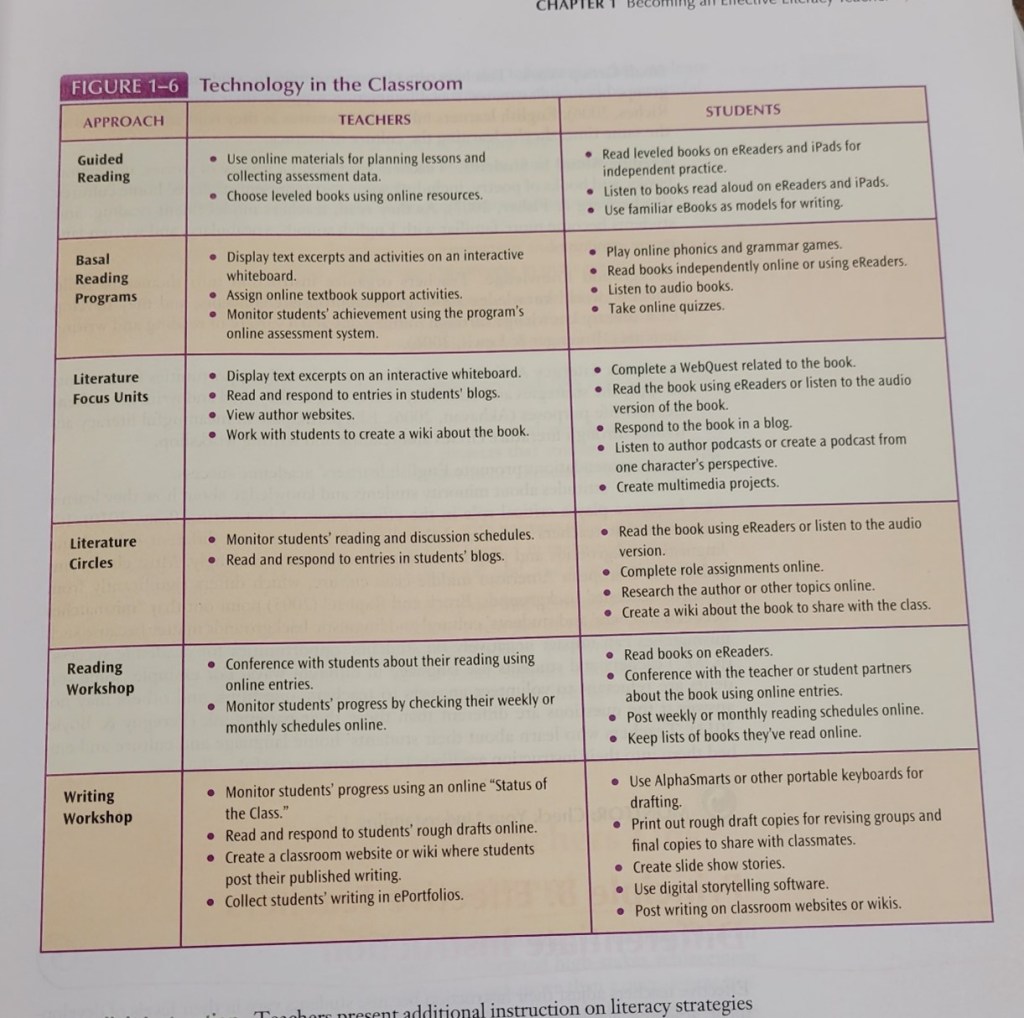
(Tompkins, G. E., 2017, pg. 27)
- Principle 8: Effective Teachers Differentiate Instruction
- Effective teachers realize that each student is different and is at a different point in their educational journey. Due to this, students may vary in their academic achievement and abilities.
- Education is not one size fits all.
- Differentiation is based on Vygotsky’s idea of a zone of proximal development. “If instruction is too difficult or too easy; it isn’t effective; instead, teachers must provide instruction that meets students’ instructional needs” (Tompkins, G. E., 2017, pg. 29)
- During differentiation it is important that teachers adjust the instruction as the students grasp new concepts.
- Remember: differentiation can involve adjusting content, processes, and the products that the students create.
- Examples of Differentiation:
- Instructional materials for each student based on their reading levels
- Consideration about developmental levels as well as their grade placement when deciding what to teach
- Use of assessments to determine student’s instructional needs
- Provide instruction in different formats: small groups, individual, or whole class
- Scaffolding for struggling students
- Challenging students who are more advanced
- Monitoring instruction and adjusting things if it is not successful
- Have students work individually, with partners, or in small groups
- Design projects that help engage students
- Assess students using multiple methods like visually, orally, or written (Tompkins, 2017).
- Principle 9: Effective Teachers Link Instruction and Assessment
- Assessment is an integral part of learning and teaching successfully.
- Standardized testing can’t be the only form of assessment that your students get
- Teachers collect and analyze data from observations, conferences, classroom tests and then they use this information to make decisions about students’ academic achievement and plan interventions as needed.
- Purposes for assessment of students’ learning:
- Determining Instructional Levels
- Monitoring Progress
- Diagnosing Strengths and Weaknesses
- Documenting Learning (Tompkins, 2017)
- Assessment is an integral part of learning and teaching successfully.
- The Instruction-Assessment Cycle
- Assessment is linked directly to instruction for teachers to be effective.
- Teachers complete assessments before they begin to teach, while they are teaching, and after they finish teaching to help ensure that they understand what they learned.
- Instruction and Assessment are linked through a four-step cycle
- Planning: Teachers use background knowledge of students reading levels and other information to ensure that instruction is not too easy or too difficult
- Monitoring: Teachers monitor instruction in progress by observing students, holding conferences, and checking their work. Monitoring this ensure that their instruction is effective. If it isn’t, they make modifications including reteaching material as needed.
- Evaluating: Teachers use rubrics, checklists, and other materials to assess student reading and writing projects and assignments. They also collect samples of reading and writing to track student achievement.
- Reflecting: Teachers regularly assess the effectiveness of their instruction by analyzing assessment results and considering how student performance is impacted by their instruction (Tompkins, 2017).
- Classroom Assessment Tools
- Teachers use a variety of informal assessment tools.
- Observation of students as they participate in instructional activities
- Running Records
- Examination of student’s work
- Conferences with students about reading and writing
- Rubrics to assess student performance (Tompkins, 2017).
- All of these assessment tools help to support instruction and teachers use the ones that best give them the information they need to ensure they are effective.
- Teachers use a variety of informal assessment tools.
- High-Stakes Tests
- Beginning in 2nd grade, the results of yearly high-stakes tests provide even more evidence about literacy achievement against CCSS.
- The usefulness of standardized testing is limited however because these tests are usually administered in the spring and the results usually aren’t given to the teachers until the end of the year.
- The teachers that the students will have the following year can look at the information, but it is not as effective in helping a teacher to determine a student’s proficiency level as it would be if they could get the results in the fall of that year.
Source:
Tompkins, G. E. (2017). Literacy for the 21st Century: A balanced approach. Pearson.
All of the information from the reading this week was incredibly useful for future applications in my own classroom. Something that really stuck with me was the differentiation that is needed when you have English Learners within your classroom. I understood that learning English is a complex process, but I never fully understood how that could impact their reading and writing capabilities. When a student is learning English there are many parts that go into that process: not only are they learning to read and write in English, but they also must learn how to speak the language and use the mechanics of it.
Because of this it is extremely important to the success of these students that teachers are regularly reevaluating their performance with instruction. In my future classroom, or in the classrooms that I am currently in with ELs in them, I am going to do my best to try to integrate as many opportunities for group work to occur as possible. Children learn well from their peers, and have a tendency to absorb more of the ways that English works when they hear it from people in their own age group. There are many benefits to ensuring that ELs get time with other students in their grade level.
The videos that we viewed this week were incredibly helpful in that they showed us the ways that the different types of reading instruction can take place. I have seen guided reading in small groups but have not have a lot of experience with the other options yet. The links to the videos are below so that I can reference these videos later on.
 Heather Owen : Reading and Language Arts Methods Notes
Leave a comment